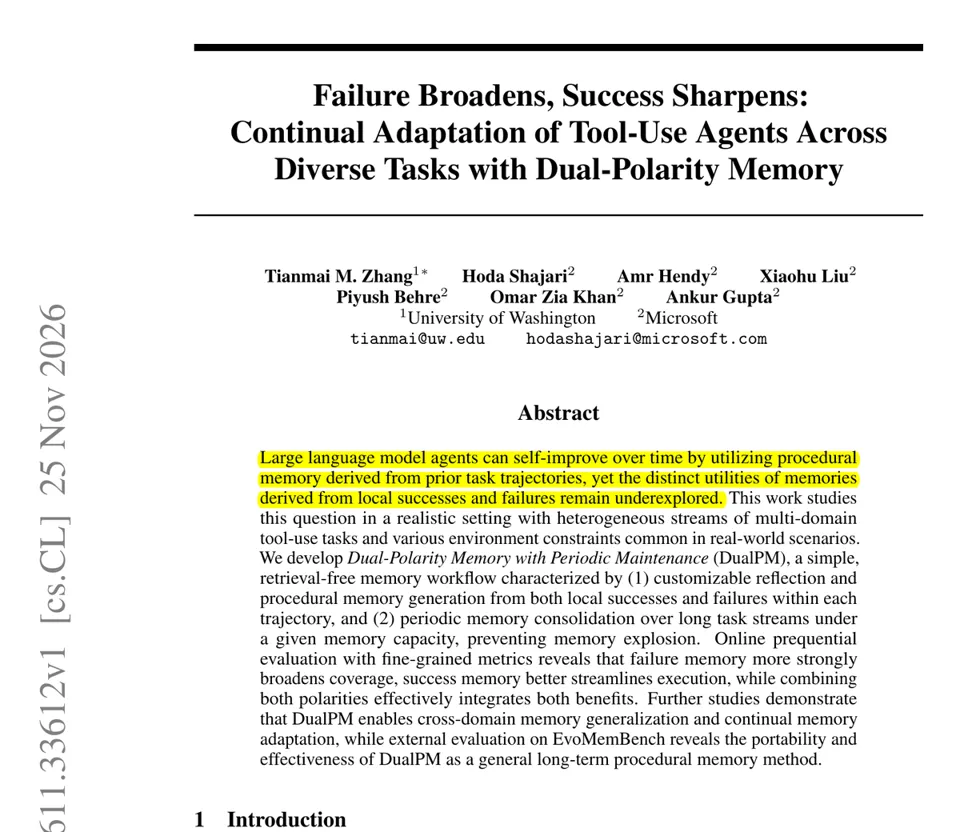
华盛顿大学与微软提出 DualPM 双轨经验学习法
华盛顿大学与微软联合论文提出 DualPM 方法,让智能体在每次任务后分别沉淀成功与失败两类经验,并每 20 个任务合并为两个有上限的经验列表。在 GPT-5.5 上测试 720 个多领域工具调用任务显示,失败经验将所需工具发现率从 75.2% 提升至 81.0%,成功经验将交互轮次从 6.1 降至 5.4,两者合用使答案准确率从 68.1% 升至 73.2%。结论是失败经验拓宽工具搜索范围,成功经验提升执行效率,成本敏感场景可仅用成功经验。
报道正文
Rohan Paul (@rohanpaul_ai) · 2026-11-26 21
New University of Washington and Microsoft paper finds that lessons from an agent's failures widen its tool search, while lessons from successes make it faster.
Agents can improve over time by saving lessons from past tasks, but most methods learn mainly from wins or judge only final success. It was unclear whether lessons from failures and successes do different jobs.
They built DualPM, which reflects on every run, writes success and failure lessons, and merges them into 2 capped lists every 20 tasks. They tested it with GPT-5.5 on 720 multi-domain tool-use tasks per setting, with tools hidden behind a search function.
Failure lessons raised the share of needed tools found from 75.2% to 81.0%, while success lessons cut turns from 6.1 to 5.4. Using both lifted answer accuracy from 68.1% to 73.2%.
For agents that learn on the job, keep separate lessons from failures and successes, and use success lessons alone when cost matters most.