Meta Open-Sources 816B Multimodal Model Runnable on Two Mac Studios
Meta has open-sourced Muse Spark Open, an 816-billion parameter multimodal model claimed to be the strongest open-weight model from the US. It supports a 1-million token context and native audio/video processing, optimized for complex coding and long-horizon reasoning. The key breakthrough is its accessibility: it can run locally on just two Apple Mac Studios, eliminating the need for cloud infrastructure or API costs.
Full Report

Just now, Meta announced a major update: Muse Spark Open is officially open-source.
The official positioning is bold: "The most powerful open-weight model in the US to date."
Parameter count: 816B (816 billion).
Context window: 1 million tokens.
Native multimodality: Natively supports text, images, video, and audio.
Designed specifically for coding tasks and scenarios requiring complex reasoning, suitable for long-horizon tasks, complex software engineering problems, and multi-step reasoning scenarios.
The most surprising aspect is that two Apple Mac Studios are enough to run this 816B behemoth.
No server rooms required, no expensive cloud compute, and no API taxes. Your desktop becomes a supercomputer!
The 816B "Multimodal Specialist"
What the current open-source ecosystem lacks are "super agents" capable of handling heavy lifting.
Muse Spark Open was built for exactly this purpose.
It specializes in long-horizon tasks, complex software engineering, and multi-step reasoning. It is tailor-made for coding and agentic workflows.
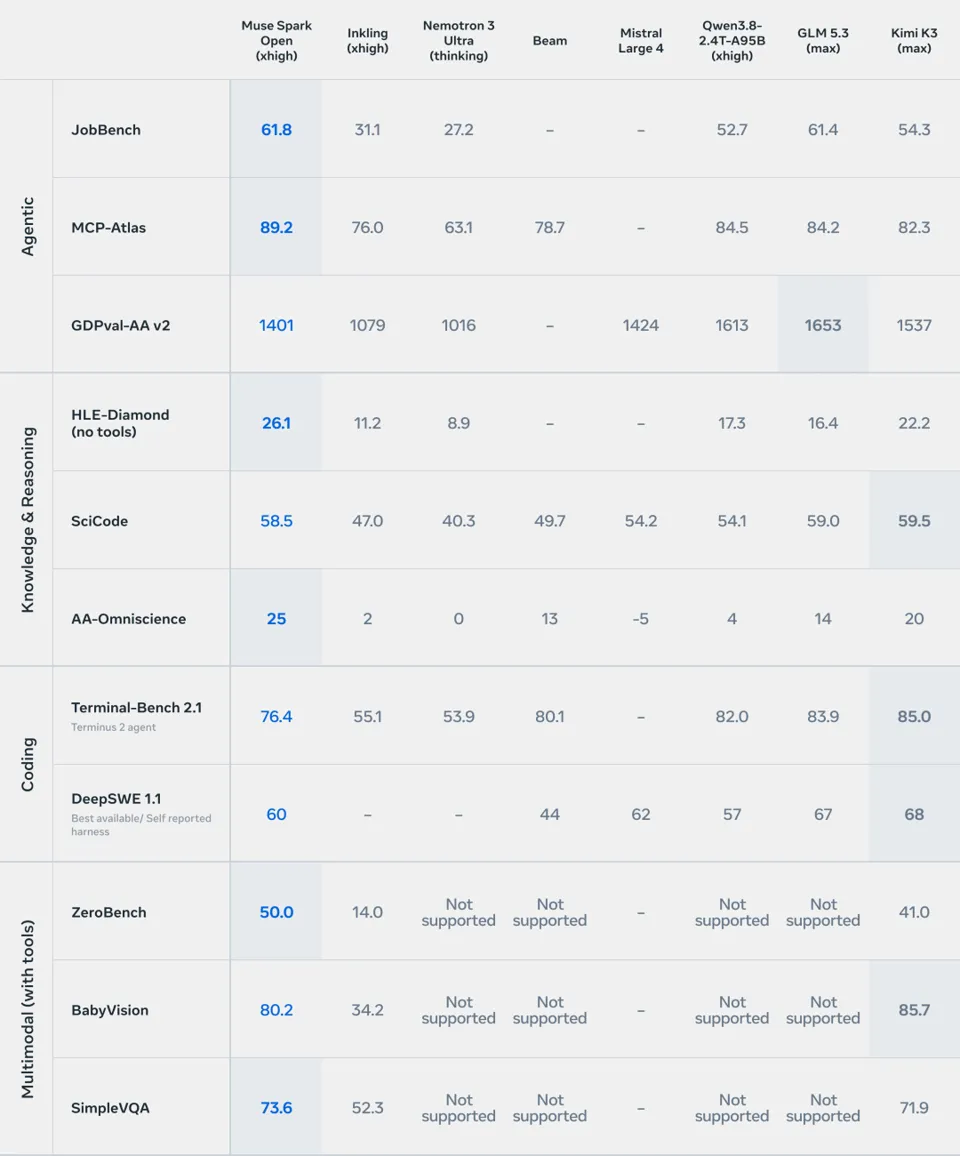
Its core technical specifications are as follows.
Total parameters: 816B; Active parameters: 42B. This utilizes a typical Mixture-of-Experts (MoE) architecture, balancing high intelligence with impressive inference efficiency.
1M Token Context Window. A 1-million-token context is sufficient to accommodate an entire large-scale software codebase or dozens of thick technical manuals. It remembers every instruction you give, never forgetting.
Native Multimodality. Text, images, audio, and video capabilities are fused natively from the ground up. It can interpret UI design mockups, understand voice commands, and analyze video frame by frame.
In short, it is a hexagonal warrior with no weaknesses.
Additionally, Meta's model weights are available for download on Hugging Face, AWS SageMaker, Google Cloud, and Microsoft Foundry.
Major API platforms such as Baseten, Fireworks, Groq, Modal, Nebius, OpenRouter, and Together AI will also launch support today.
Even more remarkable is its license—the Muse Model License.
The Muse Model License grants the right to run, modify, fine-tune, distill, and redistribute the software, subject to its terms and usage policy.
The revenue clause targets enterprises offering the model as a service. If the licensee and its affiliates have combined total revenue exceeding $20 million USD over any consecutive 12-month period, they must notify Meta and sign a separate written agreement before offering Spark Open or its derivatives in their model-serving business.
This means that the vast majority of developers can use it commercially for free. Meta is directly handing weapons to developers worldwide.
Meta Teams Up with Apple: Two Macs Equal One AI Supercomputer
An 816B model was previously a nightmare for ordinary developers.
The VRAM requirements alone would deter 99% of users. You would need to purchase massive amounts of GPUs and set up complex distributed clusters.
But this time, Meta and Apple have joined forces to break the laws of physics.

To run Muse Spark Open, all you need is two Apple Mac Studios equipped with the M5 Ultra chip.
Why Mac Studio? The secret lies in Apple's "Unified Memory Architecture."
The M5 Ultra chip gives each Mac Studio up to 512GB of unified memory. Connect two together, and you have 1TB.
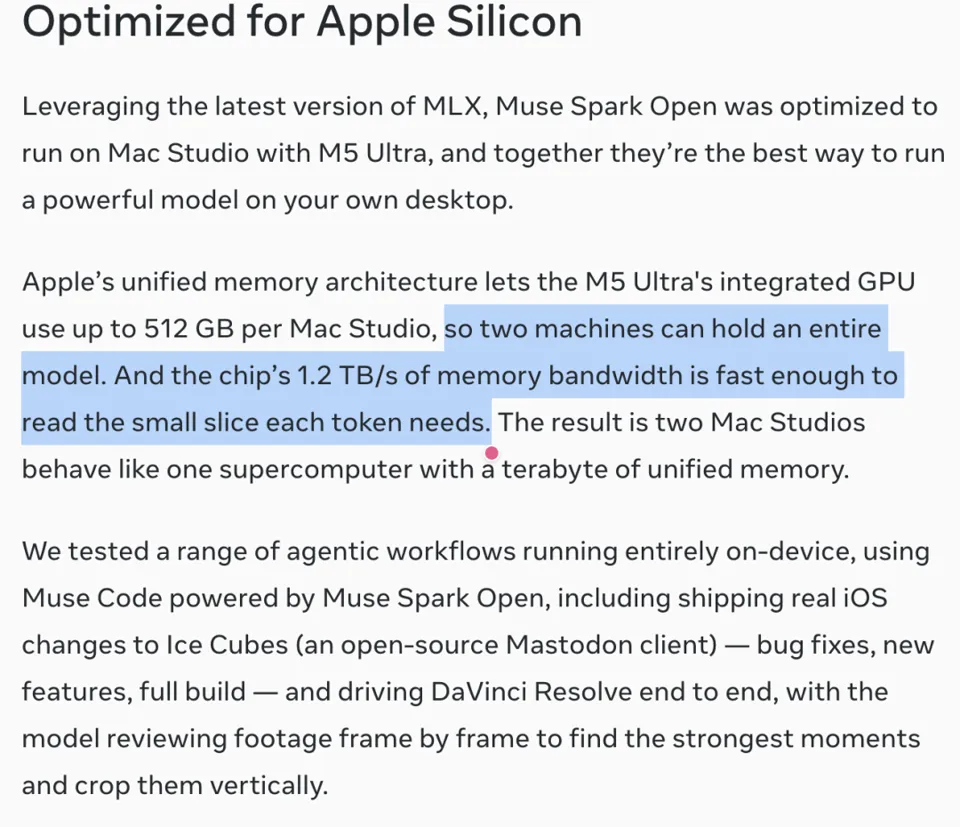
With 1TB of unified memory and the M5 Ultra's massive 1.2 TB/s memory bandwidth, the speed is sufficient to read the tiny slices required for every token.
Powered by the latest Apple MLX framework, these two silver boxes on your desk transform into a supercomputer with terabyte-scale memory.
Meta AI lead Alexandr Wang stated directly:
Many powerful open-source models are too large for ordinary computers to run.
But the Apple Mac Studio provides enough memory to make running Muse Spark Open highly practical.
Of course, it’s not cheap: a fully configured M5 Ultra Mac Studio costs around $10,799, meaning two units total over $20,000.
However, for over $20,000, you acquire a permanently online, offline-capable, absolutely secure, top-tier AI employee. For startups, independent developers, and video studios, this is clearly a worthwhile investment.
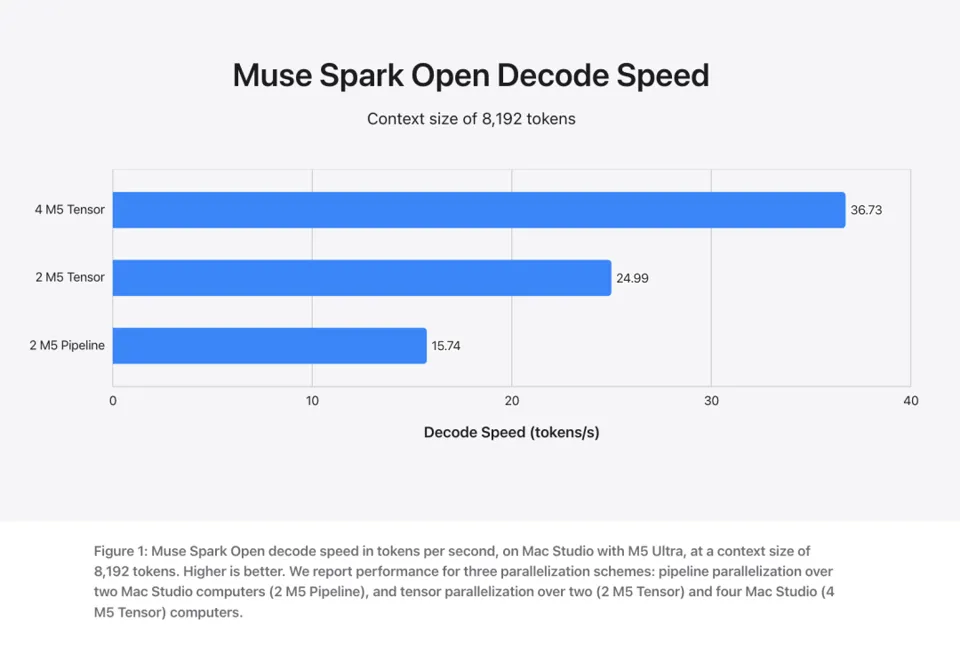
On a cluster of four Mac Studios, Muse Spark Open can generate more than 36 tokens per second, far exceeding the average human reading speed.
Beyond Apple, it is also fully compatible with other hardware, perfectly adapting to mainstream inference engines:
Chips from NVIDIA, AMD, and Intel;
Engines such as SGLang, vLLM, TensorRT-LLM, and llama.cpp. Notably, within SGLang, it delivers up to a 3.95x kernel-level speedup for both NVIDIA and AMD GPUs.
Using speculative decoding on four NVIDIA Blackwell GPUs, Muse Spark Open achieves throughput exceeding 50,000 tokens per second per GPU and over 600 tokens per user.
Superintelligence has officially descended to the desktop!
Meta provided two extremely hardcore local, edge-side agentic workflows, powered by Muse Code driven by Muse Spark Open:
Delivering real iOS changes to the open-source Mastodon client Ice Cubes—fixing bugs, adding features, and performing full builds;
And driving DaVinci Resolve end-to-end, where the model reviews footage frame-by-frame to identify the most expressive moments and perform vertical cropping.
This means you are no longer just a tool user, but a foreman for agents. Ultimate privacy, extreme performance—this is the ultimate form of edge-side Agents!
A Century-Long Reconciliation: The Epic Alliance Between Meta and Apple
Behind the flashy technical specs of Muse Spark Open lies a dramatic commercial cold war.
To ensure this model runs smoothly on Macs, Meta and Apple—two century-old rivals in Silicon Valley—actually shook hands.
This alliance is rare and incredible.
It is worth noting that Apple and Meta were once at odds, fiercely opposed to one another.
Apple’s former CEO, Tim Cook, repeatedly criticized Meta publicly for violating user privacy.
In turn, Zuckerberg retorted, mocking Apple for having "invented nothing good since the iPhone."
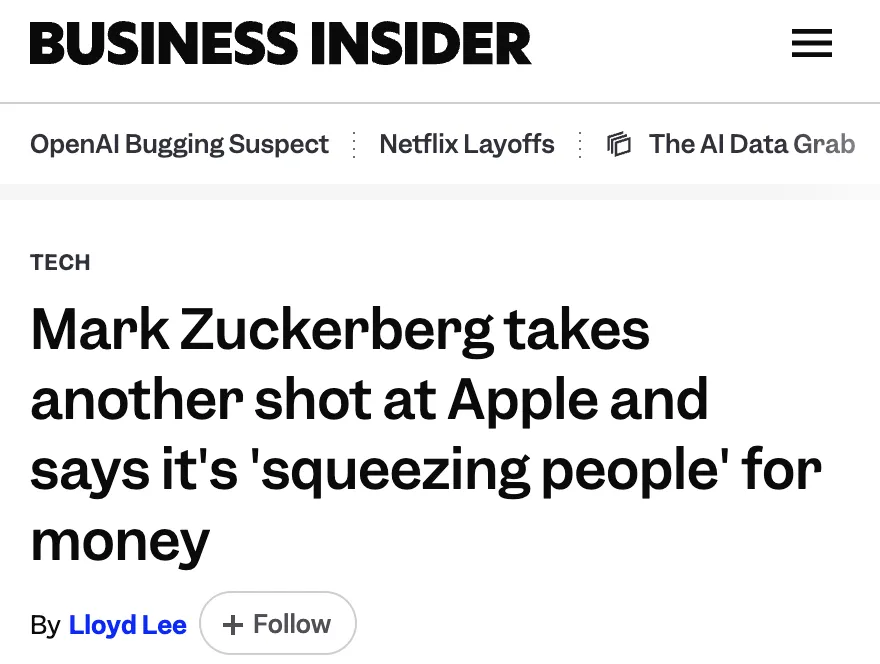
In 2021, Apple introduced strict App Tracking Transparency (ATT) policies, directly hitting Meta’s advertising business. At the time, Meta bitterly estimated that this policy cost the company a full $10 billion in revenue in 2022.
But times have changed.
Now, Apple has a new CEO: hardware enthusiast John Ternus. Meanwhile, Meta’s AI authority has been handed to the young Alexandr Wang.
John Ternus quickly joined the conversation: "Congratulations to the team! It’s astonishing to see a model of Muse Spark Open's scale and caliber running so efficiently on a desktop. The Mac Studio continues to push the boundaries of on-device AI!"
When two industry giants set aside their differences for a common goal, the entire landscape of the sector is bound to shift.
The Era of Desktop Superintelligence Has Arrived!
In 1984, Apple liberated computing from massive server rooms with the first Macintosh, placing it directly onto personal desks.
Today, in 2026, Meta and Apple have joined forces to liberate superintelligence from vast cloud server clusters using Muse Spark Open, bringing it back to the desk once again.
The era of desktop-grade superintelligence officially begins today. If you are a developer, entrepreneur, or creator, you can now run these models on just two Macs.
Your personal supercomputing center has arrived!
References:
https://research.meta.ai/blog/muse-spark-open
https://www.axios.com/2026/10/15/apple-and-meta-bury-the-hatchet-for-ai
Chasing ASI in Seconds
⭐ Like, Share, and Watch – One Click Triple Combo ⭐
Star us to stay updated with instant news from New Intelligence Era!