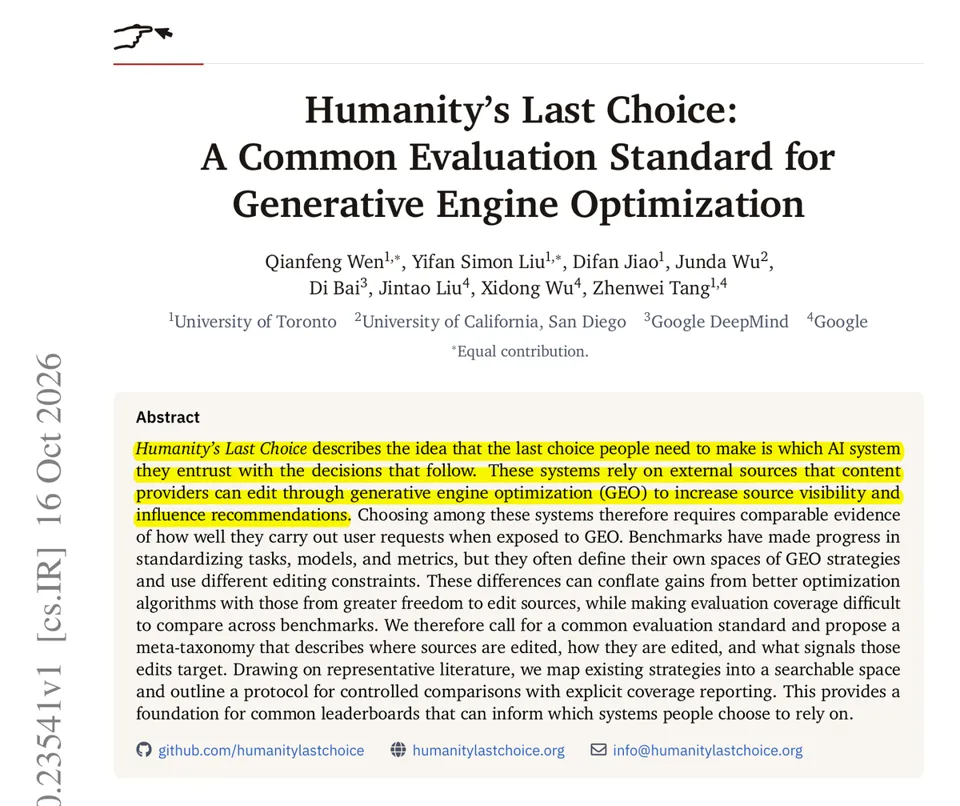
多伦多大学与谷歌提出 GEO 标准化评估框架
多伦多大学与谷歌联合发表论文,指出生成式引擎优化(GEO)缺乏统一标准导致基准测试不可比。研究提出通过标记页面修改位置、方式及目标线索来规范评估,并呼吁在比较不同方法时关注允许的编辑范围及回答质量指标。该论文目前为理论映射,未包含实验数据。
报道正文
Rohan Paul (@rohanpaul_ai) · 2026-10-25 07
New University of Toronto and Google paper argues that picking an AI assistant may be the last big decision people make, since that assistant then makes the decisions that follow.
Argues that tests of how websites game AI answers need shared editing rules, or scores can't be compared.
Content owners now edit web pages so AI assistants cite or recommend them, a practice called generative engine optimization, or GEO. Current GEO benchmarks allow different edits, so a method that rewrites whole pages can look better than one that only appends a line.
They propose labeling every GEO edit by where the page changes, how it changes, and which cue it targets, such as authority. Tests would fix the allowed edits and report visibility, answer quality, and rule-following together.
The paper runs no experiments. Its evidence is a mapping of 11 published GEO methods, showing that each covers a different slice of the possible edits.
When comparing GEO methods or AI systems, check which edits each score allowed and whether answer quality was measured.