Rohan Paul (@rohanpaul_ai) · 2026/10/11 06:19:23
WUJI Hand 2 开源:基于 MuJoCo 与 PPO 实现 20 自由度机械手转笔 Sim-to-Real 迁移
WUJI 发布并开源了具备 20 个独立驱动关节的 WUJI Hand 2,展示了在物理仿真中训练后直接部署到实物的“转笔”高难度灵巧操作能力。该方案利用 mjlab 工具包在 MuJoCo 中并行运行 4096 份虚拟副本,结合近端策略优化(PPO)算法学习 40 种参考动作轨迹,实现了从仿真到现实的高效迁移。目前代码及配置指南已完全开源,支持开发者复现这一基于强化学习的灵巧手控制范式。
报道全文原始报道全文
Rohan Paul (@rohanpaul_ai) · 2026-10-10 22
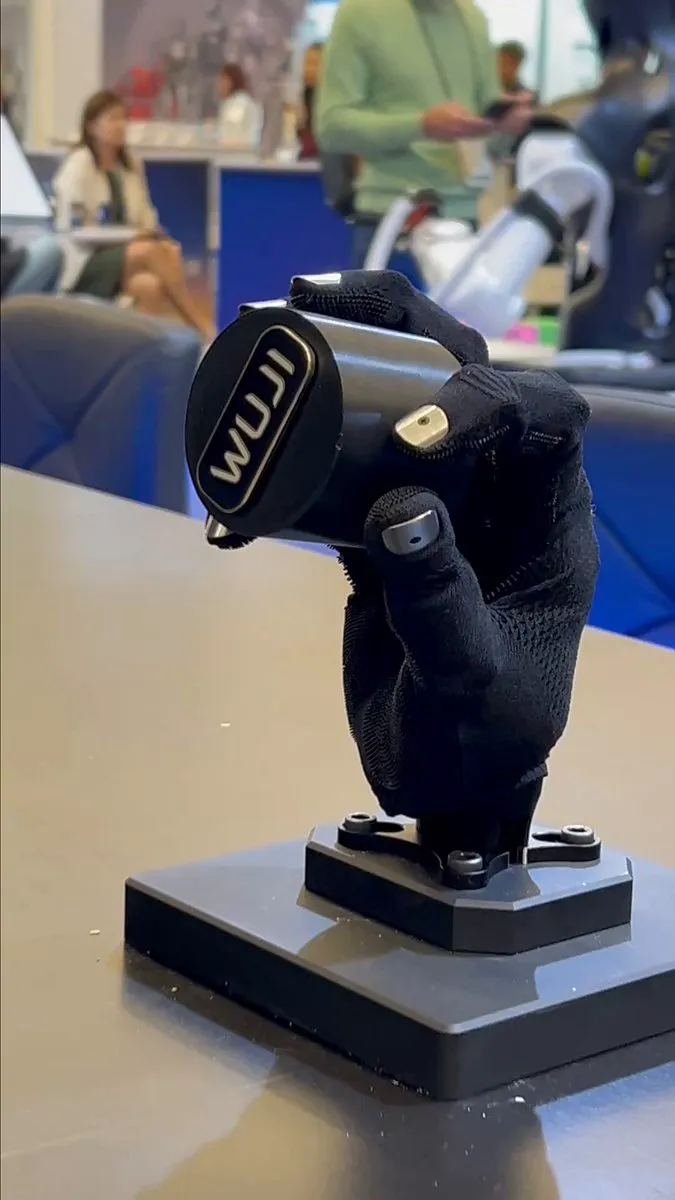
Another beautiful robotic hand.
WUJI trained its 20-joint robot hand, WUJI Hand 2, to spin a pen inside a physics simulator, then ran that same trained policy on the real hand.
It showed this around IROS 2026 (the International Conference on Intelligent Robots and Systems), together with a sensor glove that lets a person control the hand live.
Pen spinning is a hard test for a robot hand, because the pen keeps rolling, sliding and passing between fingers, and one finger moving a bit late drops it. @wuji_global’s Hand 2 has 20 joints, four per finger, each independently driven by its own motor, and supports a 1,000 Hz control rate.
Training used mjlab, a robot-learning toolkit built on the MuJoCo physics simulator, running 4,096 virtual copies of the hand at the same time with PPO (Proximal Policy Optimization), a reinforcement learning method where the AI improves by trial and error and gets rewarded for good moves.
The AI learns to follow 40 recorded pen motions in 5 groups, from a simple turn around 1 axis up to continuous spins across several axes, and it keeps correcting its fingers whenever the pen drifts from the plan.
On the real hand, the policy sends targets to all 20 joints 50 times a second, while an industrial camera tracks printed markers on both ends of a 250mm 3D-printed pen plus a tag on the wrist, so the AI always knows where the pen is.
The glove covers the other way of teaching a robot: 5 electromagnetic sensors at the fingertips track each finger's position and angle 120 times a second with about 10ms delay or less, and software turns that into joint angles the robot hand copies.
A 526-point pressure grid on the glove's palm also records how hard the person grips, which makes it useful for collecting training data for robots that learn by copying humans.
WUJI released the code, motion clips, trained models and printable pen files under the open Apache 2.0 license, so a lab with a WUJI Hand 2, a camera and an NVIDIA GPU can repeat the whole setup.
↳ 引用 @wuji_global (WUJI): Pen spinning on WUJI Hand 2, from simulation training to real-world execution.
We use motion-reference tracking and reinforcement learning to bring a simulation-trained policy to the physical hand.
Code and setup guides are open source for developers and researchers to build on.
Code: