Hcompany 开源 Holo4:驱动通用计算机操作智能体
Hcompany 正式开源 Holo4 系列模型,专为构建通用计算机操作(Computer-Use)智能体设计。该模型支持 BF16、FP8、NVFP4 及 4-bit GGUF 等多种量化格式,并配套发布轻量级 Holotron4 Nano 模型,旨在通过高效推理加速实现复杂的 GUI 自动化任务。
报道正文
本文目录13 个章节
Holo4:驱动通用计算机使用智能体
团队文章 发布于 2026 年 9 月 28 日 点赞 85
Maxime Theillard h-maxime Hcompany Frederic Renard frenard-h Hcompany Vincent Coyette vincentcoyette Hcompany Emrick Sinitambirivoutin emricksini-h Hcompany Avshalom Manevich avshalom-h Hcompany Antonio Loison antonioloison Hcompany Antoine Bonnet ABonnetH Hcompany Maxime Langevin maxime-hcompany Hcompany Aleix Cambray (H-AI) h-aleixcambray Hcompany Léonard Benedetti l-benedetti Hcompany Tony Wu tonywu71 Hcompany Mats L. Richter MatsLRichter Hcompany Michael Eickenberg michaelhai Hcompany Sławek Mucha smucha-h Hcompany Matthias Brunel mbrunel-H Hcompany Daniel Beechey daniel-beechey-h Hcompany
Holo4 是我们全新的智能体模型系列。该系列包含两种规格:27B 稠密模型和 35B-A3B 混合专家(MoE)模型。两者均可通过 H Models API 获取。此外,我们还发布了 Holotron 3 的更新版本:Holotron4 Nano。
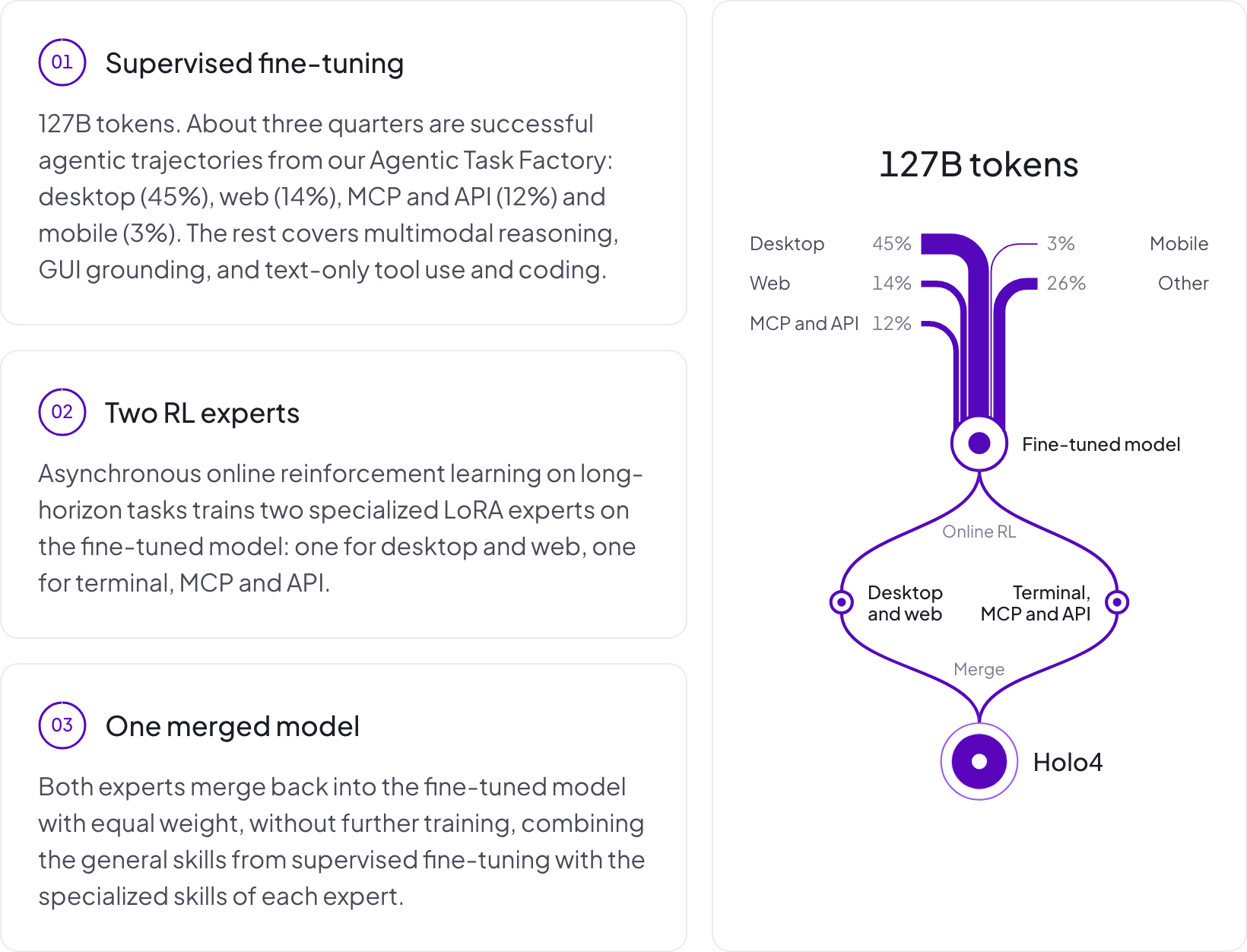
Holo4 基于我们之前的模型构建,能够通过任何可用接口与软件交互:GUI、代码、MCP 和 API。它在学术基准测试中表现优异,但我们的设计初衷是服务于真实的业务工作流。该模型通过监督学习和强化学习在大量环境和任务上进行训练,其中包括由我们的 Agentic Task Factory(智能体任务工厂)生成的任务。
立即开始:
- 🤖 模型: Holo4-27B | Holo4-35B-A3B | Holotron4 Nano
- 🗂️ 完整合集 (FP16, FP8, GGUF): Holo4
- 🎞️ 轨迹数据: 查看器 | 数据集
- ⚡ H Models API: 快速入门
- 📝 完整博客文章: hcompany.ai/newsroom/holo4
为每种接口打造的模型
Holo4 可以在屏幕上点击和输入,编写并运行自己的代码,以及调用 MCP 或 API 工具。它会根据任务选择最合适的方式。大多数智能体模型仅针对单一接口进行训练:专注于 GUI 的模型在没有屏幕时便“失明”,而偏好工具调用的模型在面对没有 API 的应用程序时则束手无策。真实的工作并非如此割裂,单个业务任务往往需要结合这些不同的方法。
Holo4 可在桌面端、Web 端、Android 系统、代码沙箱以及业务 API 上运行。在所有情况下使用的都是同一个模型,且调用方式相同。你无需为每个平台选择不同的模型。
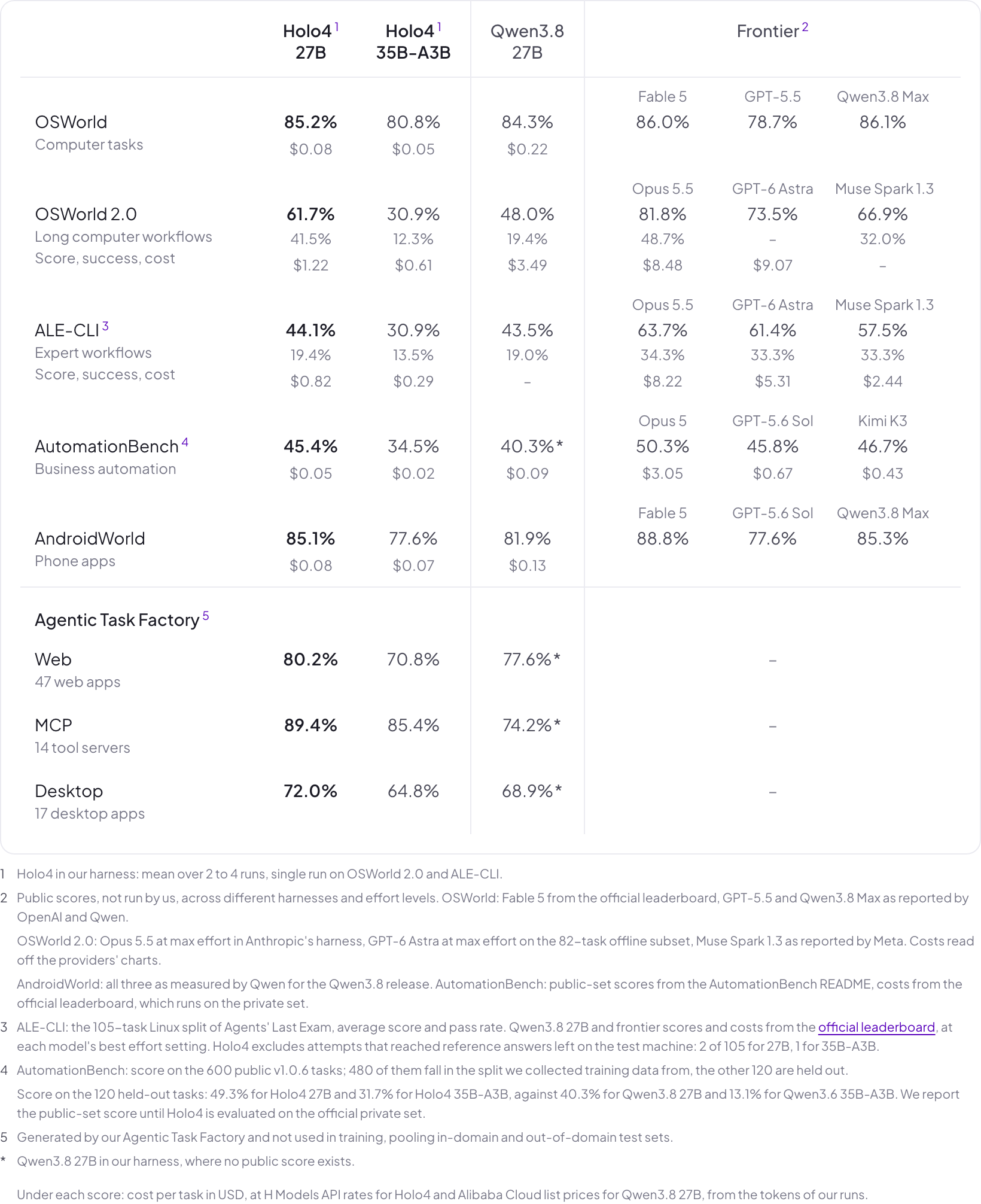
Holo4 模型相较于其 Qwen 基座模型有显著提升。在长工作流方面,Holo4 仅次于最强的闭源模型:在 OSWorld 2.0 基准测试中,Holo4 27B 得分为 61.7%,而 Opus 5.5 为 81.8%;Holo4 35B-A3B 达到 30.9%。然而,它实现这一成绩所需的参数量少几个数量级,成本也低得多。我们将公开基准测试得分背后的所有轨迹数据开源:你可以在 trajectories.hcompany.ai 重放每一步操作,或从 Hugging Face 下载这些数据。
Competitive with the frontier, at a fraction of the cost
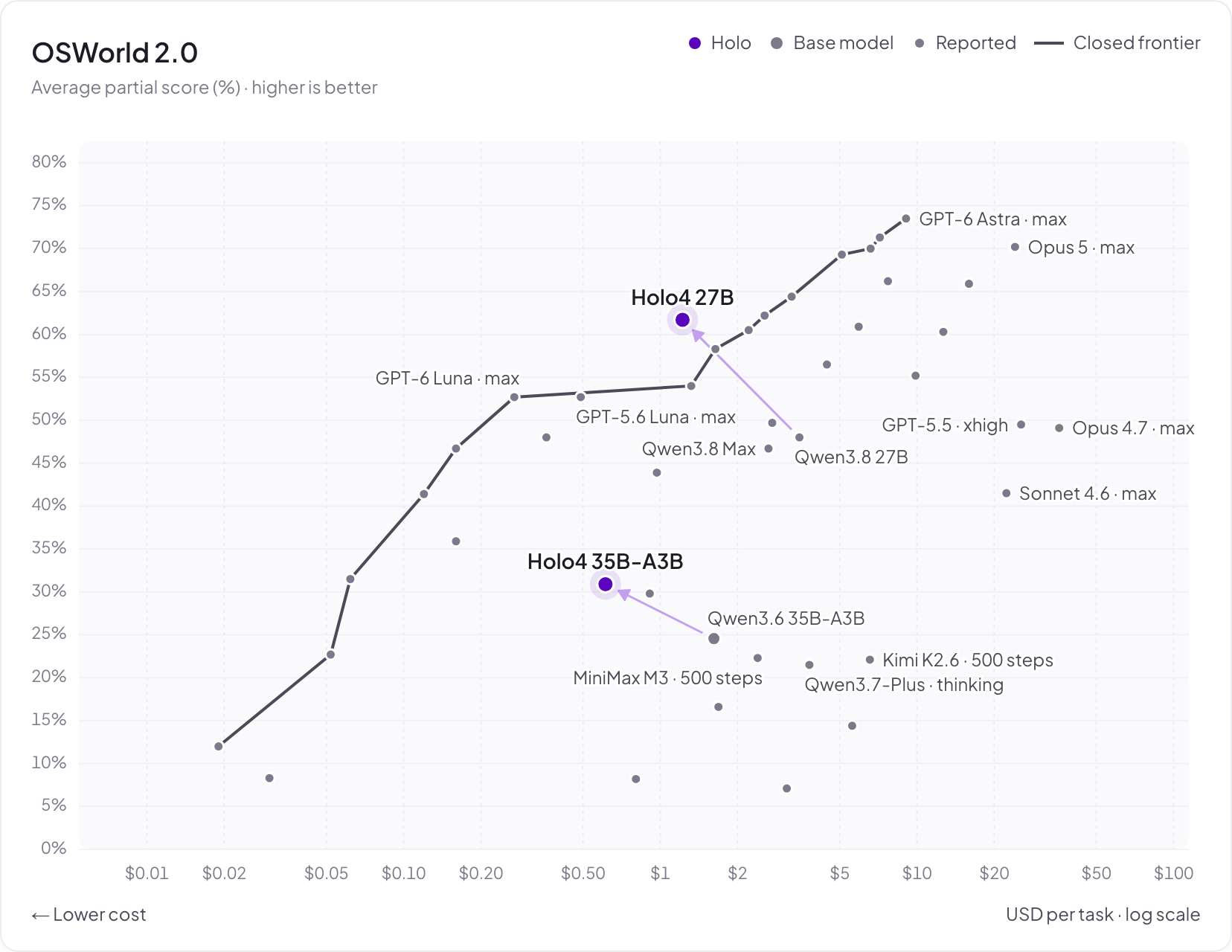
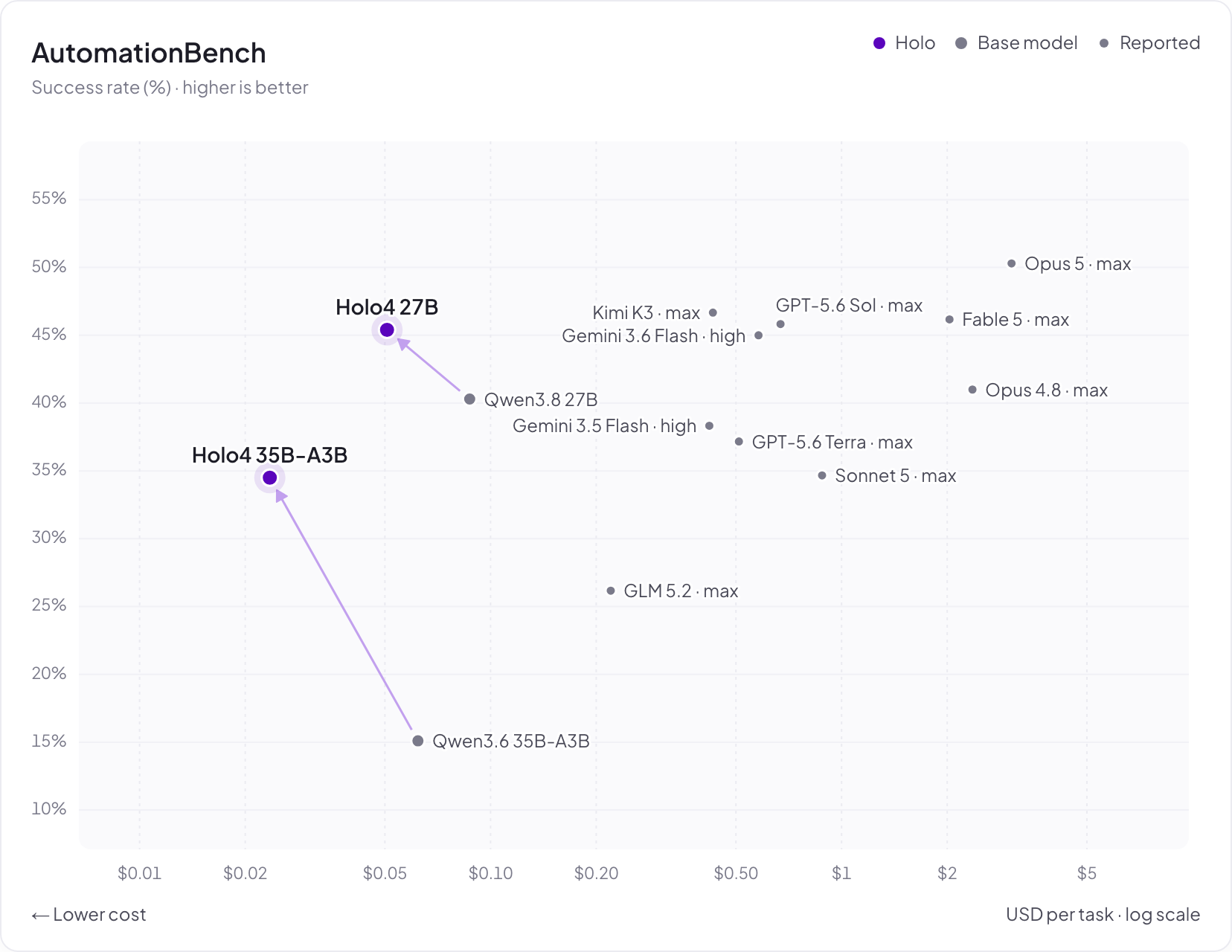
On the hardest academic benchmarks for desktop control (OSWorld 2.0) and API use (AutomationBench), Holo4 competes with frontier models at a much lower cost per task.
Notes on the cost-performance charts
OSWorld 2.0. Costs are estimated from the input and output tokens of each agentic run. Holo4 is priced at H Models API rates (single run). Qwen3.8 27B: model card score, cost from the tokens of our run at Alibaba Cloud list prices. Qwen3.6 35B-A3B: single run in our harness, at Alibaba Cloud list prices with cache hits at 20% of the input price. OpenAI launch data supplies the GPT and Opus effort sweeps; other closed and open-weight points use the official OSWorld 2.0 leaderboard. Releases, harnesses and task subsets differ. The line connects non-dominated score and cost pairs among the closed models; Holo4 is excluded.
AutomationBench. Holo4, Qwen3.8 27B and Qwen3.6 35B-A3B: AutomationBench v1.0.6, scores and costs measured in our internal harness. Other models: public-set scores from the AutomationBench README, cost per task from the official leaderboard, which runs on the private set. We will report Holo4 on the private set once it is evaluated.
AI that does work
Trained on environments and tasks from our Agentic Task Factory, Holo4 models excel on professional software. The examples below show Holo4 27B alongside Qwen3.8 27B, its base model. Same prompt and harness for both models.
3D modeling · Eiffel tower
Build a 3D model of the Eiffel Tower in FreeCAD, at a scale of 1 mm to 1 metre, centred on the origin and aligned to the X and Y axes. Work to this design. The tower is square in plan at every height, never round. Its half-width, measured from the central axis out to the corner, is 62.5 mm at ground level, 32.5 mm at height 57, 17.5 mm at height 115, and 9.35 mm at height 276. Between those heights the half-width follows a smooth curve that falls steeply near the ground and gently higher up, never a straight line. Four identical legs, one per quadrant, each a square column whose outer corner follows that profile. Each leg is 14 mm across at the ground and tapers to 4 mm at height 276. The legs stand apart from the ground up to the first platform, and converge as they rise. Nothing fills the space between them: the tower is open, and you can see straight through it from every side. Three platforms, each a solid square slab centred on the axis: 72 mm across and 4 mm thick at height 57; 40 mm across and 3 mm thick at height 115; 22 mm across and 3 mm thick at height 276. A mast from height 276 to 324, square, 8 mm across at its base tapering to 2 mm at the tip. Every part must be a closed solid with non-zero volume, and no part may fill the space between the legs.
Holo4 27B (84 calls, 1.3M tokens)
Qwen3.8 27B (60 calls, 1.0M tokens)
3D modeling · H logo
Build a 3D model in FreeCAD of the H company logo: a solid filled disc beside a blocky sans-serif capital letter H, both extruded to the same thickness, the two shapes of similar height and set apart so they do not overlap, with the centre of the disc level with the middle of the H. Colour both shapes black.
Holo4 27B (94 calls, 1.5M tokens)
Qwen3.8 27B (118 calls, 1.9M tokens)
Game design · Pac-Man
[注:本文篇幅超长,以上为核心前篇精译,后续内容保留原文呈现]
Build a Pac-Man-style game in Godot and leave it running. A rectangular maze of walls laid out on a grid, with pellets filling every open corridor. A player marker moves continuously along the corridors, eating each pellet it passes over and scoring a point for it. Three ghosts move through the same corridors and chase the player. If a ghost catches the player, the player loses a life and everything resets to its starting position. Score and lives are drawn on screen. No one is going to play this. The player drives itself with a simple heuristic: at each junction it heads toward the nearest pellet, unless a ghost is close, in which case it moves away from the ghost. The game must run unattended and indefinitely, with no keyboard input at all. When it works, start the game and leave it playing.
Holo4 27B (68 calls, 2.4M tokens, 268 lines)
Qwen3.8 27B (197 calls, 11.4M tokens, 327 lines)
How we built Holo4
Agentic task factory
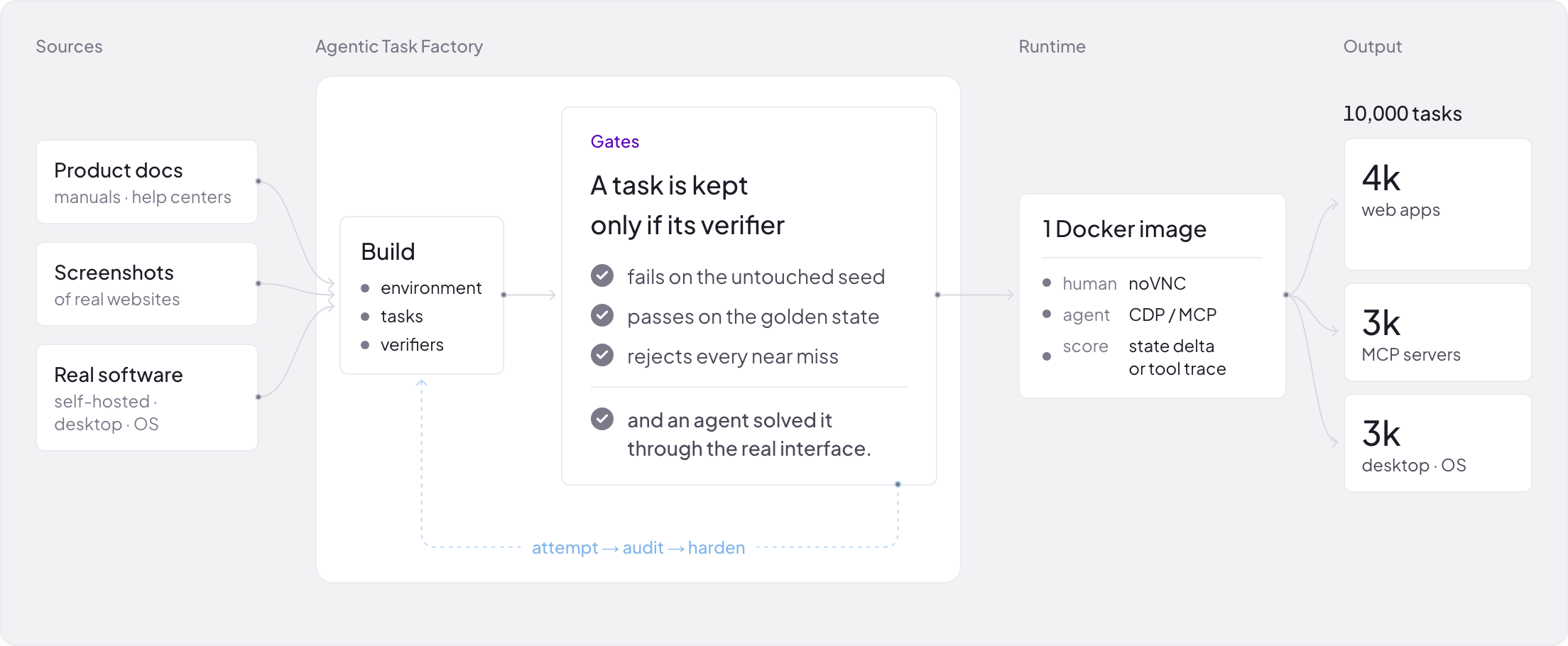
Our internal set of agentic pipelines builds interactive environments and verifiable tasks from documentation alone, such as screenshots of real websites or open-source software. So far it has produced about 10,000 tasks across web apps, MCP servers and desktop environments, including hybrid environments that expose the same state through a GUI and MCP.
Training
Harness
Alongside training, we rebuilt our harness, the loop that executes the model's actions and manages its context over hundreds of steps, using feedback from agentic performance on OSWorld 2.0. Agents tagged why each task failed and engineers reviewed their fixes. The largest changes were giving the agent a reliable memory that can keep track of hundreds of steps, and a shell on the desktop machine itself.
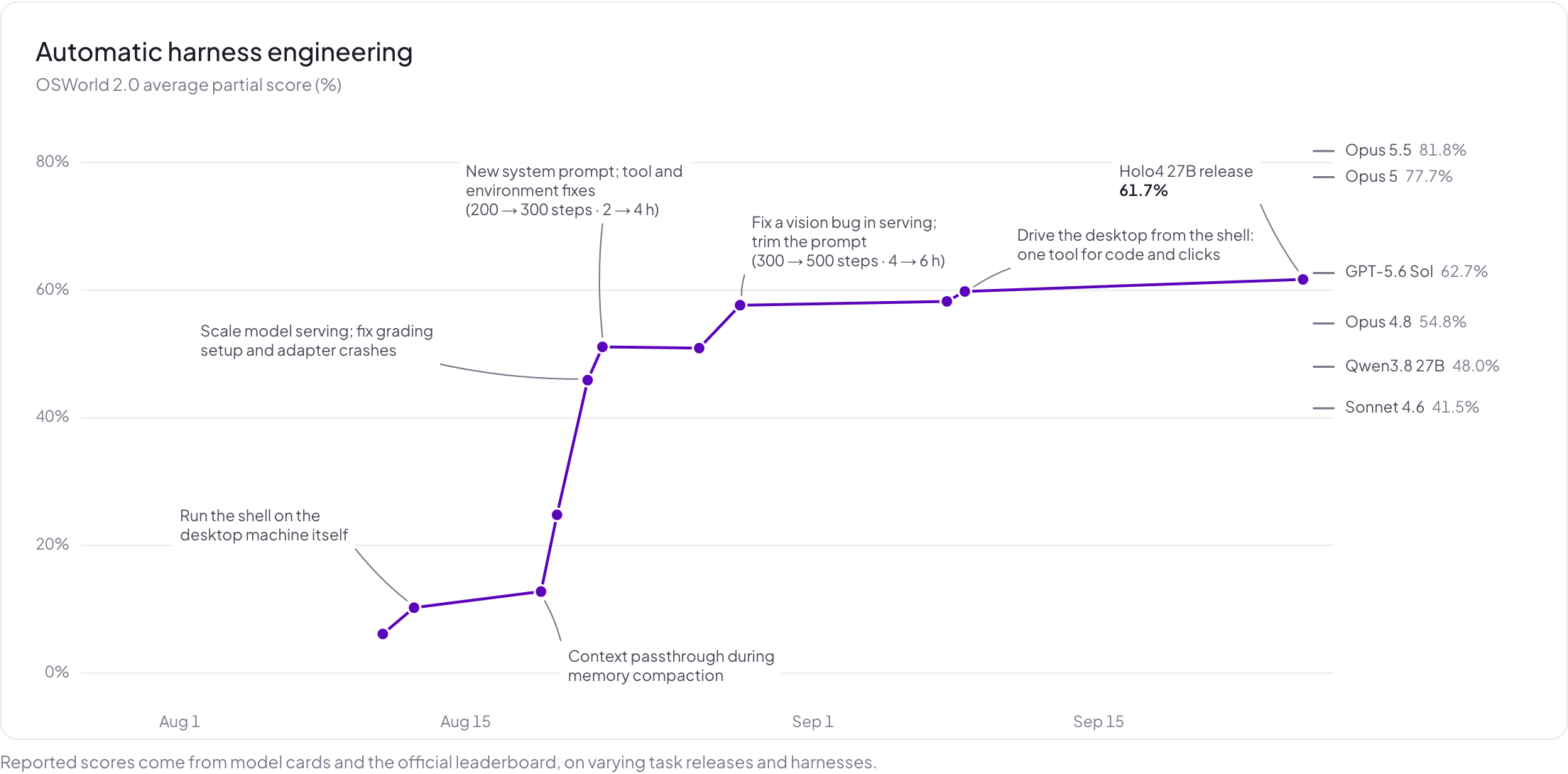
Opus 5 (70.2%) and GPT-5.6 Sol (66.2%) use max-effort partial rewards on the v2026.08.08 offline set from OpenAI's launch chart, as in the cost-performance plot. Other reference scores come from model cards and the official leaderboard. Task releases, subsets and harnesses vary.
Holotron4 Nano
Our post-training stack is designed to adapt to new foundation models and produce agents that generalize across interfaces and environments. As a member of the NVIDIA Nemotron Coalition, we applied our latest stack to the Nemotron 3 Nano Omni model as a follow-up to Holotron 3.
The same recipe turns Nemotron 3 Nano Omni into Holotron4 Nano, a generalist agentic model that significantly improves over the base model on GUI workflows and in environments exposing MCP, APIs or coding sandboxes.
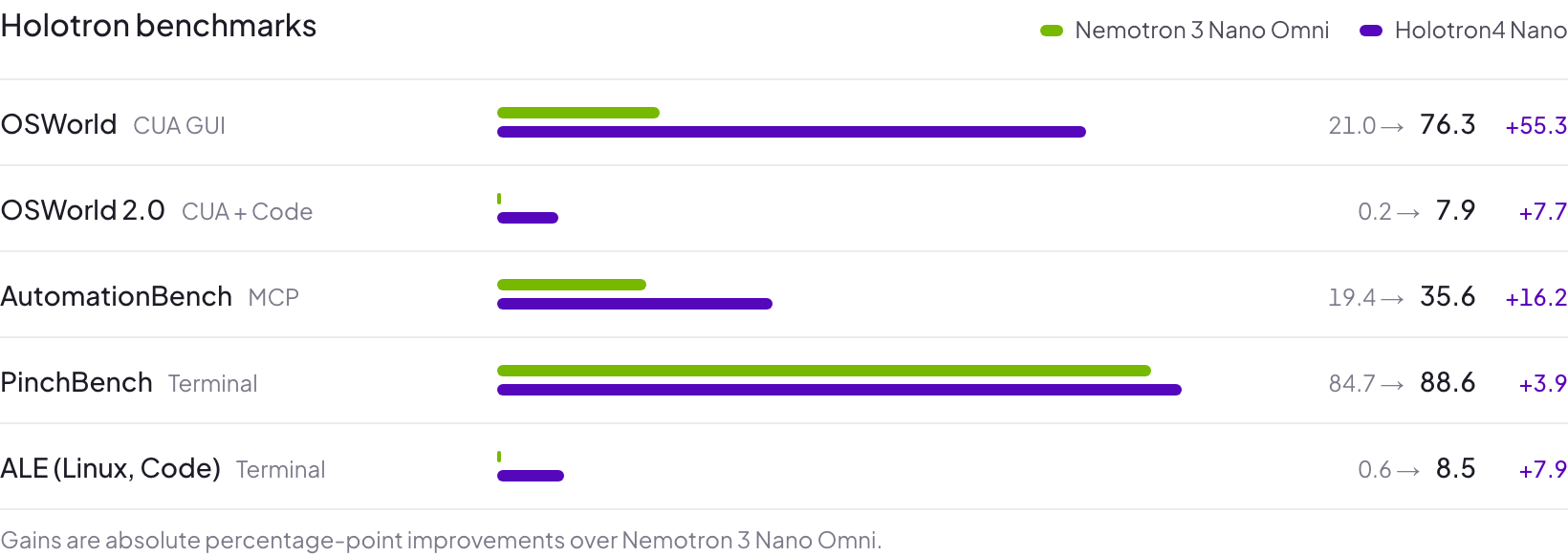
Gains are absolute percentage-point improvements over Nemotron 3 Nano Omni.
These gains show that our recipe transfers well and can turn a generalist model into an agentic expert. Nothing in it is size-specific.
Run it yourself
Both sizes are available today on the H Models API. Weights are on Hugging Face in BF16, FP8, NVFP4 and 4-bit GGUF, next to our small model, Holotron4 Nano.
We will release optimized DSpark drafter checkpoints in the coming days to further accelerate inference.