Hugging Face 推广开放数据集托管指南
Hugging Face 发布博客文章,鼓励研究人员在 Hub 上分享和托管开放机器学习数据集。该指南旨在降低数据共享门槛,强调其在开源生态中的重要性,并列举了 NVIDIA、Google 等机构的使用案例。
报道正文
本文目录20 个章节
在 Hugging Face Hub 上分享你的开放 ML 数据集!
发布于 2024 年 11 月 12 日 在 GitHub 上更新 点赞 32
Daniel van Strien davanstrien Caleb Fahlgren cfahlgren1 Quentin Lhoest lhoestq Ann Huang erinys
本文也有简体中文版本:简体中文。
如果你正在从事数据密集型研究或机器学习项目,你需要一种可靠的方式来分享和托管你的数据集。像 Common Crawl、ImageNet、Common Voice 这样的公共数据集对于开放的 ML 生态系统至关重要,但它们的托管和分享往往颇具挑战。
Hugging Face Hub 让数据集的托管与分享变得无缝顺畅,并受到众多领先研究机构、企业和政府机构的信赖,包括 Nvidia、Google、Stanford、NASA、THUDM 以及 巴塞罗那超级计算中心。
通过在 Hugging Face Hub 上托管数据集,你可以立即获得一系列功能,从而最大化你工作的影响力:
宽松的限额
对大型数据集的支持
The Hub can host terabyte-scale datasets, with high per-file and per-repository limits. If you have data to share, the Hugging Face datasets team can help suggest the best format for uploading your data for community usage. The 🤗 Datasets library makes it easy to upload and download your files, or even create a dataset from scratch. 🤗 Datasets also enables dataset streaming , making it possible to work with large datasets without needing to download the entire thing. This can be invaluable to allow researchers with less computational resources to work with your datasets, or to select small portions of a huge dataset for testing, development or prototyping.
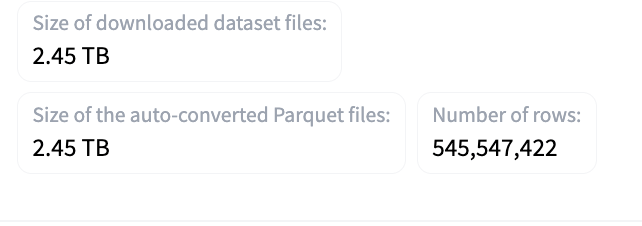
The Hugging Face Hub can host the large datasets often created for machine learning research.
Note: The Xet team is currently working on a backend update that will increase per-file limits from the current 50 GB to 500 GB while also improving storage and transfer efficiency.
Dataset Viewer
Beyond just hosting your data, the Hub provides powerful tools for exploration. With the Datasets Viewer, users can explore and interact with datasets hosted on the Hub directly in their browser. This provides an easy way for others to view and explore your data without downloading it first.
Hugging Face datasets supports many different modalities (audio, images, video, etc.) and file formats (CSV, JSON, Parquet, etc.), and compression formats (Gzip, Zip, etc.). Check out the Datasets File Formats page for more details.

The Dataset Viewer for the Infinity-Instruct dataset.
The Datasets Viewer also includes a few features which make it easier to explore a dataset.
Full Text Search
Built-in Full Text Search is one of the most powerful features of the Datasets Viewer. Any text columns in a dataset immediately become searchable.
The Arxiver dataset contains 63.4k rows of arXiv research papers converted to Markdown. By using Full Text Search, it's easy to find the papers containing a specific author such as Ilya Sutskever below.
Sorting
The Datasets Viewer allows you to sort the dataset by clicking on the column headers. This makes it easy to find the most relevant examples in a dataset.
Below is an example of a dataset sorted by the helpfulness column in descending order for the HelpSteer2 dataset.
Third Party Library Support
Hugging Face is fortunate to have third party integrations with the leading open source data tools. By hosting a dataset on the Hub, it instantly makes the dataset compatible with the tools users are most familiar with.
Here are some of the libraries Hugging Face supports out of the box:
| Library | Description | Monthly PyPi Downloads (2024) |
|---|---|---|
| Pandas | Python data analysis toolkit. | 258M |
| Spark | Real-time, large-scale data processing tool in a distributed environment. | 29M |
| Datasets | 🤗 Datasets is a library for accessing and sharing datasets for Audio, Computer Vision, and Natural Language Processing (NLP). | 17M |
| Dask | Parallel and distributed computing library that scales the existing Python and PyData ecosystem. | 12M |
| Polars | A DataFrame library on top of an OLAP query engine. | 8.5M |
| DuckDB | In-process SQL OLAP database management system. | 6M |
| WebDataset | Library to write I/O pipelines for large datasets. | 871K |
| Argilla | Collaboration tool for AI engineers and domain experts that value high quality data. | 400k |
Most of these libraries enable you to load or stream a dataset in 1 single line of code.
Here are some examples with Pandas, Polars and DuckDB:
import pandas as pd
df = pd.read_parquet("hf://datasets/neuralwork/arxiver/data/train.parquet")

import polars as pl
df = pl.read_parquet("hf://datasets/neuralwork/arxiver/data/train.parquet")

import duckdb
duckdb.sql("SELECT * FROM 'hf://datasets/neuralwork/arxiver/data/train.parquet' LIMIT 10")
You can find more information about integrated libraries in the Datasets documentation. Along with the libraries listed above, there are many more community supported tools which support the Hugging Face Hub such as Lilac and Spotlight.
SQL Console
The SQL Console provides an interactive SQL editor that runs entirely in your browser, enabling instant data exploration without any setup. Key features include:
- One-Click: Open a SQL Console to query a dataset with a single click
- Shareable and Embeddable Results: Share and embed interesting query results
- Full DuckDB Syntax: Use full SQL syntax with built-in functions for regex, lists, JSON, embeddings, and more
On every public dataset you should see a new SQL Console badge. With just one click you can open a SQL Console to query that dataset.
Querying the Magpie-Ultra dataset for excellent, high quality reasoning instructions.
Security
While making datasets accessible is important, protecting sensitive data is equally crucial. The Hugging Face Hub provides robust security features to help you maintain control over your data while sharing it with the right audiences.
Access Controls
The Hugging Face Hub supports unique access control options for who has access to the dataset.
-
Public: Anyone can access the dataset.
-
Private: Only you and those in your organization can access the dataset.
-
Gated: Control access to your dataset through two options:
-
Automatic Approval: Users must provide required information (like name and email) and agree to terms before gaining access
-
Manual Approval: You review and manually approve/reject each access request
For more details about gated datasets, see the gated datasets documentation. For more fine-grained controls, there are Enterprise plan features where organizations can create resource security groups, use SSO, and more.
Built-in Security Scanning
Along with access controls, the Hugging Face Hub offers several security scanners:
[注:本文篇幅超长,以上为核心前篇精译,后续内容保留原文呈现]
| Feature | Description |
|---|---|
| Malware Scanning | Scans files for malware and suspicious content at each commit and visit |
| Secrets Scanning | Blocks datasets with hardcoded secrets and environment variables |
| Pickle Scanning | Scans pickle files and shows vetted imports for PyTorch weights |
| ProtectAI | Uses Guardian tech to block datasets with pickle, Keras and other exploits |

To learn more about these scanners, see the security scanners documentation.
Reach and Visibility
Having a secure platform with powerful features is valuable, but the true impact of research comes from reaching the right audience. Reach and visibility are crucial for researchers sharing datasets - it helps maximize research impact, enables reproducibility, facilitates collaboration, and ensures valuable data can benefit the broader scientific community.
With over 5M builders actively using the platform, the Hugging Face Hub provides researchers with powerful tools for community engagement and visibility. Here's what you can expect:
Better Community Engagement
- Built-in discussion tabs for each dataset for community engagement
- Organizations as a centralized place for grouping and collaborating on multiple datasets
- Metrics for dataset usage and impact
Wider Reach
- Access to a large, active community of researchers, developers, and practitioners
- SEO-optimized URLs making your dataset easily discoverable
- Integration with the broader ecosystem of models, datasets, and libraries
- Clear links between your dataset and related models, papers, and demos
Improved Documentation
- Customizable README files for comprehensive documentation
- Support for detailed dataset descriptions and proper academic citations
- Links to related research papers and publications
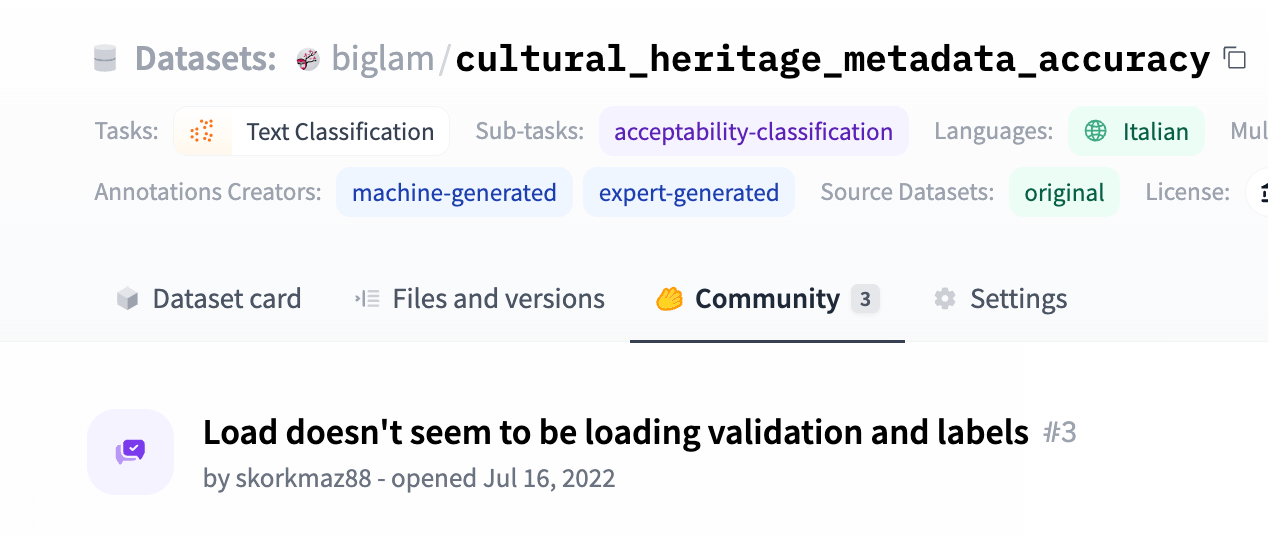
The Hub makes it easy to ask questions and discuss datasets.
How can I host my dataset on the Hugging Face Hub?
Now that you understand the benefits of hosting your dataset on the Hub, you might be wondering how to get started. Here are some comprehensive resources to guide you through the process:
-
General guidance on creating and sharing datasets on the Hub
-
Guides for particular modalities:
-
Creating an audio dataset
-
Creating an image dataset
-
Creating a video dataset
-
Guidance on structuring your repository so a dataset can be automatically loaded from the Hub.
The following pages will be useful if you want to share large datasets:
- Repository limitations and recommendations provides general guidance on some of the considerations you'll want to make when sharing large datasets.
- The Tips and tricks for large uploads page provides some guidance on how to upload large datasets to the Hub.
If you want any further help uploading a dataset to the Hub or want to upload a particularly large dataset, please contact [email protected].
Datasets mentioned in this article 1
More Articles from our Blog
[
roboticsaidatasets
NVIDIA's GTC 2025 Announcement for Physical AI Developers: New Open Models and Datasets
- +1
42 March 18, 2025](https://huggingface.co/blog/nvidia-physical-ai)[

communitydatasetssynthetic-data
Docmatix - a huge dataset for Document Visual Question Answering
80 July 18, 2024](https://huggingface.co/blog/docmatix)
Community
it would be nice to have a small section on (showing off datasets linkages) how to link the datasets to eachother and to models in the dataset card
Hello @lhoestq and the Hugging Face team, Sorry the long comment but hope it would be worth it.🙏🏿.
Thank you for this comprehensive guide on sharing datasets on the Hub! Your emphasis on making datasets accessible while maintaining security and visibility resonates deeply with our recent work. We recently launched the Ugandan Cultural Context Benchmark (UCCB) on Hugging Face (https://huggingface.co/datasets/CraneAILabs/UCCB), which represents a significant milestone for African AI evaluation. As the first comprehensive benchmark testing AI's understanding of African cultural contexts, UCCB addresses a critical gap where models often fail due to training data that predominantly reflects Western experiences.
Your article's points about reach and community engagement particularly struck us. With only 0.02% of internet content in African languages and Africa contributing less than 1% to global AI training data, initiatives like UCCB are essential for building more inclusive AI systems. The dataset features 1,039 expert-verified questions across 24 cultural domains, from traditional medicine to modern slang, testing whether AI truly understands African contexts beyond mere translation.
We believe sharing the story behind UCCB and our methodology could inspire similar initiatives across Africa and other underrepresented regions. While we attempted to join the Blog Explorers organization to share our journey, we understand access is limited. However, we wonder if there might be an opportunity to collaborate with Hugging Face experts on a blog post that highlights:
How African researchers are leveraging the Hub's infrastructure to address regional AI challenges The importance of culturally-aware benchmarks in the global AI ecosystem Practical insights for other regions looking to create similar evaluation frameworks The role of community collaboration in building datasets that truly represent diverse perspectives
As you noted in your article, "the true impact of research comes from reaching the right audience." We believe showcasing African AI innovation on Hugging Face's platform could inspire more regional contributions and demonstrate how the Hub enables researchers worldwide to shape AI development, not just consume it.
Would you or someone from the team be open to exploring a collaborative blog post? Even guidance on independently publishing our story in a way that aligns with Hugging Face's community values would be invaluable. We're committed to the same principles of open science and community engagement that make the Hub special.(We have tried to reach out to the team at Hugging Face but no one has given us any time for months now🥲).
Thank you for building infrastructure that empowers global voices in AI. Looking forward to any opportunities to share how African perspectives are contributing to more equitable AI development.
Best regards, Kato Steven Mubiru & Bronson Bakunga @katostevenmubiru P.S. The Dataset Viewer and SQL Console features you highlighted have been instrumental in making UCCB accessible to researchers with limited computational resources - exactly the democratization we need for inclusive AI development!
Upload images, audio, and videos by dragging in the text input, pasting, or clicking here. Tap or paste here to upload images