Rohan Paul (@rohanpaul_ai) · 2026/10/19 14:02:18
亚马逊研究揭示智能体记忆评估盲区
亚马逊最新论文指出,仅靠端到端问答(QA)评分无法准确评估智能体记忆系统的有效性。通过构建 FEB-30 基准测试,研究发现 QA 得分与底层存储事实状态存在显著偏差,导致错误掩盖或正确被误判。建议开发者在部署时直接验证每个更新后的存储事实,而非仅依赖最终输出结果。
报道全文原始报道全文
Rohan Paul (@rohanpaul_ai) · 2026-10-19 06
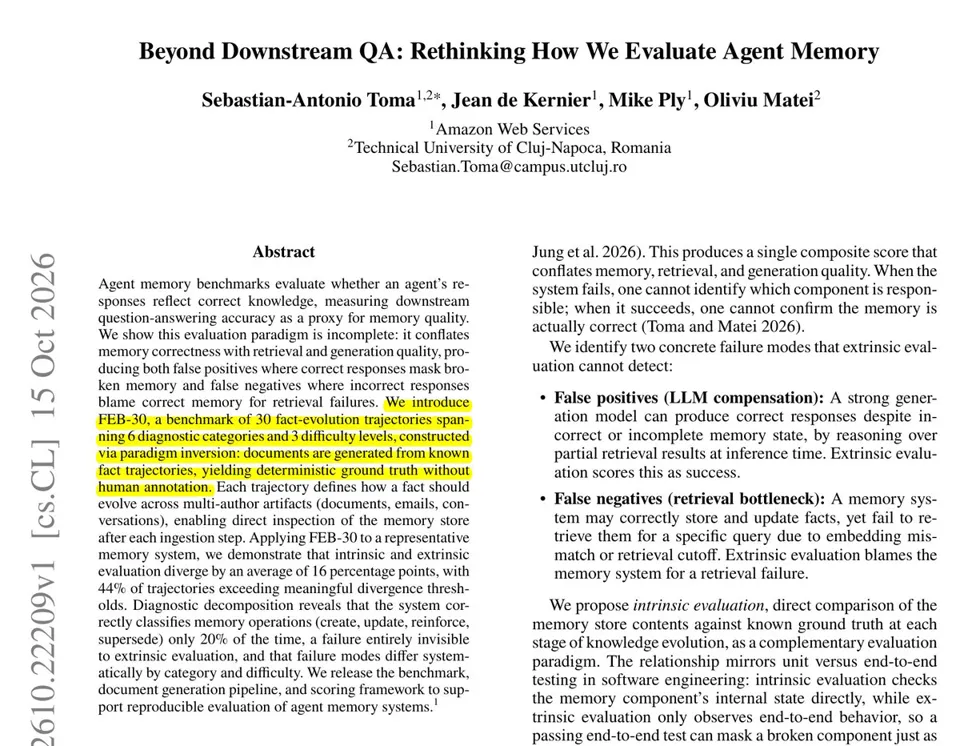
New Amazon paper shows that teams shipping agent memory should check what actually got stored, since QA scores alone did not reveal which pipeline stage was failing.
Agent memory benchmarks grade the agent's answers, which mixes memory with retrieval and answer writing. A strong LLM can hide a broken memory store, and a retrieval miss can make a correct one look bad.
They built FEB-30, 30 scripted fact histories turned into 147 documents, so the correct memory state is known after every document. On a memory system built like Mem0 and Hindsight, they compared the stored facts with that truth and with QA scores.
The 2 scores differed by 16.8 points on average, and pass/fail verdicts disagreed on 21% of fact histories. The system picked the right memory action, like update or reinforce, only 20.1% of the time, which QA never showed.
If you build agent memory, test the stored facts directly after each update, alongside end-to-end QA.