马普所发现开启推理让大模型错误趋同
马普所团队在 9 个 Qwen 与 GPT 模型、3 项基于美国人口普查数据的预测任务上对比推理开关状态,发现开启推理后模型间一致度上升,但全部 9 个模型同时答错的人群比例也增加 2.0 至 2.4 个百分点。对推理链最长的样本,校正后一致度降至约 0.31 至 0.39,说明长推理链更多标记出模型分歧而非共识。结论是模型集成投票的纠错假设可能失效,多模型一致不等于正确。
报道正文
Rohan Paul (@rohanpaul_ai) · 2026-11-28 01
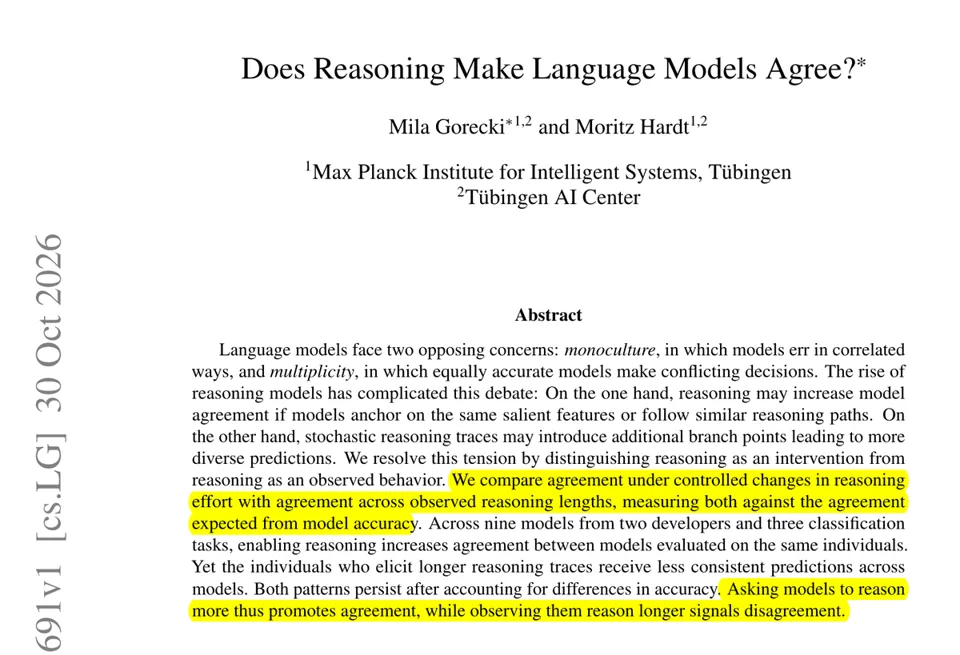
New Max Planck paper finds that turning on reasoning makes different LLMs agree more, even on mistakes, while long traces mark where they disagree.
When several LLMs judge the same person, a wrong answer from one model could be fixed by switching to another. That only works if the models do not all make the same mistakes.
The authors tested 9 Qwen and GPT models on 3 prediction tasks built from US census surveys, with reasoning on and off. They measured agreement beyond what each model's accuracy alone would predict.
With reasoning on, models agreed more, and the share of people all 9 models got wrong rose by 2.0 to 2.4 points. For people who drew the longest traces, adjusted agreement fell to about 0.31 to 0.39.
For decisions about people, check whether anyone gets a correct answer from your model set, since more agreement can also mean more shared errors.