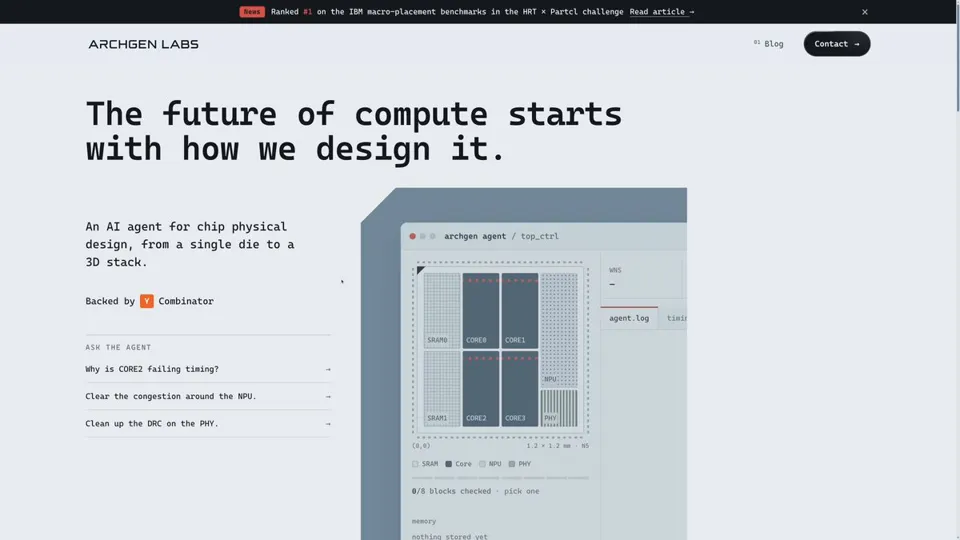
YC 初创 Archgen 用 AI 预测芯片温度提速 5000 倍
YC F26 初创公司 Archgen 正在研发三维堆叠晶体管芯片设计工具,以绕开晶体管微缩逼近物理极限的困境。其热仿真基础模型预测芯片温度比传统 EDA 工具快约 5000 倍,可将同等算力功耗降低最多 40%,并计划于 2027 年 4 月与全球头部晶圆厂合作流片首款芯片。
报道正文
Rohan Paul (@rohanpaul_ai) · 2026-11-09 20
Chips have mostly improved by shrinking transistors, and that is getting very hard.
so YC startup @archgen_ is designing chips that stack transistors in layers like a skyscraper, letting signals travel shorter distances and use less power.
Stacking chip layers is possible, but the stack traps heat, so Archgen built an AI model that predicts chip temperature about 5,000x faster than standard chip design software. i.e. it will let engineers find hot spots while they design.
And shorter wires carry less capacitance, so every switch costs less energy and settles faster. Archgen’s figure is up to 40% less power for the same work.
↳ 引用 @HariAyapps (hari_haran (building archgen YC F26)): @archgen_ is building skyscrapers for semiconductor chips
Shrinking transistors is getting harder. Stacking them makes heat harder to manage. We’re building the tools to design chips in three dimensions.
We stack transistors vertically, shorten connections, and optimize timing and heat together.
Our foundational model for thermal simulation, predicts temperature roughly 5,000× faster than conventional EDA tools.
Our placement engine ranked #1 in HRT’s macro-placement challenge
We’re working with some of the largest fabs in the world to tape out our first chip in April 2027