Open ASR 排行榜新增埃及与尼日利亚英语评测集
Hugging Face 的 Open ASR Leaderboard 新增埃及与尼日利亚英语口音的私有评测集,延续其引入留出数据以提升评测可信度的路线。此举扩大了语音识别模型在非主流英语口音上的可比评测覆盖,但属于榜单数据集的常规扩充,未涉及新模型或新方法。
报道正文
本文目录3 个章节
Egyptian and Nigerian English join the Open ASR Leaderboard
Published November 6, 2026 Update on GitHub Upvote - Eric Bezzam bezzam Follow Ashley Mo ashleymo2025 Follow liva-ai Aoi Otani aonorii Follow liva-ai
A few months ago, we added private data to the Open ASR Leaderboard: 11 splits from Appen and DataOceanAI covering scripted and conversational speech from five accents (blog). The community response was great, with many highlighting the importance of held-out sets for trustworthy evaluations. Since then, we added one more private split for Indian-accented English with Voice Arena (blog).
We’re excited to announce a new collaboration with Liva AI to add even more private data with two new accents: Egyptian 🇪🇬 and Nigerian 🇳🇬.
| Dataset | Accent | Duration [h] | Style | Transcription |
|---|---|---|---|---|
| Liva AI Conversational EG | Egyptian | 1.34 | Conversational, spontaneous | Punctuated, cased, with disfluencies. |
| Liva AI Conversational NG | Nigerian | 1.55 | Conversational, spontaneous | Punctuated, cased, with disfluencies. |
This is part of our continued effort to improve representation in ASR evals (more accents and more languages) and to improve trust (new private data to minimize benchmaxxing, and new data providers). We’re excited to see the community continuing to push ASR performance for the world 🤗
Richer accent breakdown in the Private tab
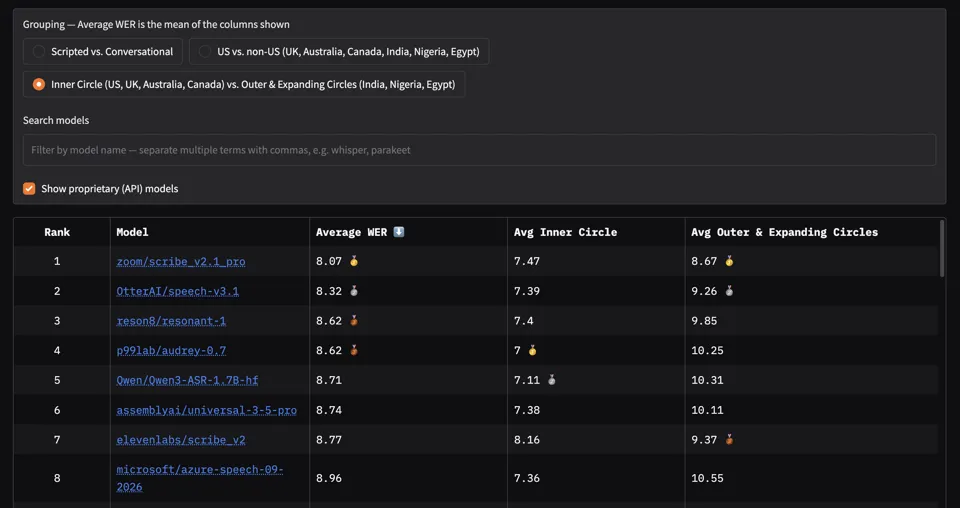
With these new accents, we can now present a richer breakdown of accents, based on Kachru’s Three Circles (kudos to Hume AI for this idea in their leaderboard). The Open ASR Leaderboard will now report:
- US vs. non-US (UK, Australia, Canada, India, Nigeria, Egypt)
- Inner Circle (US, UK, Australia, Canada) vs. Outer & Expanding Circles (India, Nigeria, Egypt)
As more accents join, we’ll split the Outer and Expanding Circles.
About Liva AI
Liva AI collects multimodal interaction data through consumer products used by real people. Because Liva owns both the collection environment and distribution, it can design products around specific model gaps across domains, industries, languages, modalities, and interaction types. This gives it access to natural, high-context behavior that emerges through real product use, rather than artificially elicited or task-based interactions.