OpenAI 发布 GPT-5.5:主打智能体编码与低延迟
OpenAI 正式推出 GPT-5.5,宣称其为最智能且易用的模型,重点提升在智能体编码、计算机操作及知识工作领域的表现。该模型能在保持与 GPT-5.4 相同每 token 延迟的前提下,显著增强多步任务规划、工具调用及自主纠错能力。目前 GPT-5.5 及其 Pro 版本已上线 API,并更新了系统卡以说明新增的安全防护措施。
关联知识实体
报道正文
本文目录21 个章节
Update on April 24, 2026: GPT‑5.5 and GPT‑5.5 Pro are now available in the API.The system cardhas also been updated to describe the additional safeguards that apply.
我们正式发布 GPT‑5.5,这是我们迄今最智能、最直观易用的模型,也是迈向计算机端全新工作方式的重要一步。
GPT‑5.5 能更快速地理解你的意图,并主动承担更多工作。它在代码编写与调试、在线调研、数据分析、文档与电子表格创建、软件操作以及跨工具协同直至任务完成等方面表现卓越。你无需精心管控每一个步骤,只需将复杂的多部分任务交给 GPT‑5.5,便可信赖它进行规划、调用工具、自查结果、处理模糊情境并持续推进。
在 agentic coding(代理式编程)、计算机使用、知识工作及早期科学研究等领域,性能提升尤为显著——这些领域的进展依赖于跨上下文推理及随时间推移采取行动的能力。GPT‑5.5 实现了智能水平的跃升,同时未牺牲速度:通常更大、更强的模型服务延迟更高,但 GPT‑5.5 在实际服务场景中保持了与 GPT‑5.4 相当的 per-token latency(单 token 延迟),却展现出更高的智能水平。此外,在完成相同的 Codex 任务时,它消耗的 token 数量显著减少,从而兼具高效性与强能力。
我们在发布 GPT‑5.5 时配备了迄今最强大的安全防护体系,旨在减少滥用风险,同时保障有益工作的访问权限。我们依据完整的安全与准备度框架对该模型进行了评估,联合内部及外部红队测试人员开展工作,针对高级网络安全和生物学能力增加了专项测试,并在发布前收集了近 200 家可信早期访问合作伙伴关于实际用例的反馈。
今日,GPT‑5.5 已向 ChatGPT 和 Codex 中的 Plus、Pro、Business 及 Enterprise 用户推出;GPT‑5.5 Pro 则向 ChatGPT 中的 Pro、Business 及 Enterprise 用户推出。API 部署需要不同的安全措施,我们正与合作伙伴和客户紧密协作,制定大规模服务所需的安全要求。我们将很快把 GPT‑5.5 和 GPT‑5.5 Pro 引入 API。
GPT‑5.5GPT‑5.4GPT‑5.5 ProGPT‑5.4 ProClaude Opus 4.7****Gemini 3.1 Pro Terminal-Bench 2.082.7%75.1%--69.4%68.5% Expert-SWE(内部评测)73.1%68.5%---- GDPval(胜或平)**84.9%83.0%82.3%82.0%80.3%67.3% OSWorld-Verified78.7%75.0%--78.0%- Toolathlon55.6%54.6%---48.8% BrowseComp 84.4%82.7%90.1%89.3%79.3%85.9% FrontierMath Tier 1–3 51.7%47.6%52.4%50.0%43.8%36.9% FrontierMath Tier 4 35.4%27.1%39.6%38.0%22.9%16.7% CyberGym81.8%**79.0%--73.1%-
模型能力
OpenAI 正在构建面向智能体 AI(Agentic AI)的全球基础设施,使世界各地的人们和企业能够借助 AI 完成工作。在过去一年中,我们见证了 AI 显著加速了软件工程的发展。随着 GPT‑5.5 在 Codex 和 ChatGPT 中的应用,同样的变革正开始延伸至科学研究以及人们在计算机上进行的更广泛的工作领域。
在这些领域中,GPT‑5.5 不仅更加智能,而且在解决问题的方式上也更加高效,通常能以更少的 token 和更少的重试次数获得更高质量的输出结果。在 Artificial Analysis 的编码指数(Coding Index)上,GPT‑5.5 以仅为竞争性前沿编码模型一半的成本,实现了最先进的智能水平。
智能体编码
GPT‑5.5 是我们迄今最强大的智能体编码模型。在 Terminal-Bench 2.0 上——该基准测试需要规划、迭代和工具协调的复杂命令行工作流——它达到了 82.7% 的最先进准确率。在 SWE-Bench Pro 上——该基准评估真实世界 GitHub issue 的解决能力——它达到了 58.6%,相比以往模型能在单次通过中端到端地解决更多任务。在 Expert-SWE 上——这是我们针对长周期编码任务的内部前沿评测,其预估人类完成时间的中位数为 20 小时——GPT‑5.5 同样优于 GPT‑5.4。
在所有三项评测中,GPT‑5.5 在使用更少 token 的同时,提升了 GPT‑5.4 的得分。
该模型的编码优势在 Codex 中表现得尤为明显,它能够承担从实现和重构到调试、测试和验证等各类工程工作。早期测试表明,GPT‑5.5 在真实工程工作所依赖的行为方面表现更佳,例如在大型系统中保持上下文连贯性、推理模糊故障、利用工具验证假设,以及在周边代码库中贯彻变更。
超越基准测试,早期测试者表示 GPT‑5.5 展现出更强的系统形态理解能力:能够洞察故障原因、定位修复切入点,并预判代码库中其他受影响的模块。
Every 的创始人兼首席执行官 Dan Shipper 将 GPT‑5.5 描述为“我使用过的第一个具备真正概念清晰度的编码模型”。
在发布一款应用后,他花了数天时间调试上线后的问题,最终不得不引入团队中最优秀的工程师来重写部分系统。为了测试 GPT‑5.5,他实际上进行了“时光倒流”实验:让模型审视故障状态,看其能否生成与那位工程师最终决定相同的重写方案。GPT‑5.4 未能做到,而 GPT‑5.5 成功了。
MagicPath 的首席执行官 Pietro Schirano 也见证了类似的飞跃:当 GPT‑5.5 将一个包含数百项前端和重构变更的分支合并到一个同样发生了重大变化的主分支时,它在约 20 分钟内一次性解决了所有冲突。
参与测试的高级工程师们表示,GPT‑5.5 在推理能力和自主性方面明显强于 GPT‑5.4 和 Claude Opus 4.7,能够提前发现潜在问题,并在无需明确提示的情况下预测测试和代码审查的需求。在一个案例中,一位工程师要求它重新架构一个协作式 Markdown 编辑器中的评论系统,返回结果是一个几乎完整的包含 12 个差异(diff)的代码栈。其他人则表示,他们只需进行极少量的实现修正,并且相比 GPT‑5.4,他们对 GPT‑5.5 制定的计划更有信心。
一位拥有该模型早期访问权限的 NVIDIA 工程师甚至直言:“失去对 GPT‑5.5 的访问权,感觉就像被截肢了一样。”
知识工作
使 GPT‑5.5 在编码方面表现卓越的优势,同样使其在日常计算机工作中威力强大。由于模型更善于理解意图,它能够更自然地贯穿知识工作的完整闭环:查找信息、识别关键内容、使用工具、检查输出,并将原始素材转化为有用的成果。
在 Codex 中,GPT‑5.5 在生成文档、电子表格和幻灯片演示文稿方面优于 GPT‑5.4。Alpha 测试者表示,它在运营研究、电子表格建模以及将杂乱的业务输入转化为计划等工作上超越了以往模型。当结合 Codex 的计算机使用技能时,GPT‑5.5 让我们更接近一种体验:模型确实能与你协同操作计算机——它能看清屏幕内容、点击鼠标、输入文字、导航界面,并在不同工具间精准切换。
OpenAI 团队已在实际工作流中运用这些优势。目前,公司超过 85% 的员工每周都在使用 Codex,涵盖软件工程、财务、传播、市场营销、数据科学和产品管理等多个职能领域。在传播部门,团队利用 Codex 中的 GPT‑5.5 分析了六个月的演讲请求数据,构建了评分与风险框架,并验证了一个自动化 Slack 代理,从而能够自动处理低风险请求,同时将高风险请求路由至人工审核。在财务部门,团队使用 Codex 审阅了共计 71,637 页的 24,771 份 K-1 税务表格,通过排除个人信息的特定工作流,相比去年将任务完成时间缩短了两两周。在市场进入(Go-to-Market)团队,一名员工实现了每周业务报告的自动生成,每周节省 5-10 小时。
在 ChatGPT 中,GPT‑5.5 Thinking 为更复杂的问题提供了更快的帮助,通过更智能、更简洁的回答,协助用户更高效地推进复杂工作。它在编程、研究、信息综合与分析以及文档密集型任务等专业工作中表现出色,尤其是在使用插件时。
在 GPT‑5.5 Pro 中,早期测试者发现 ChatGPT 所能承担的工作难度和质量均有显著提升,延迟的改善使其在处理高要求任务时更加实用。与 GPT‑5.4 Pro 相比,测试者认为 GPT‑5.5 Pro 的回答在全面性、结构清晰度、准确性、相关性和实用性方面均显著更优,尤其在商业、法律、教育和数据科学领域表现强劲。
GPT‑5.5 在反映此类工作的多个基准测试中达到了最先进(state-of-the-art)的性能水平。在 GDPval 上——该测试评估代理在 44 种职业中生成规范知识工作的能力——GPT‑5.5 得分为 84.9%。在 OSWorld-Verified 上——该测试衡量模型独立操作真实计算机环境的能力——其得分达到 78.7%。而在 Tau2-bench Telecom 上——该测试考察复杂的客户服务工作流——在不进行提示词调优的情况下,其得分高达 98.0%。此外,GPT‑5.5 在其他知识工作基准测试中也表现强劲:FinanceAgent 得分为 60.0%,内部投行建模任务 得分为 88.5%,OfficeQA Pro 得分为 54.1%。
Tau2-bench Telecom 是在未进行提示词调优(且以 GPT‑4.1 作为用户模型)的情况下运行的。GPT‑5.5 比前代模型更能理解任务意图,且在 token 效率上更高。
[注:本文篇幅超长,以上为核心前篇精译,后续内容保留原文呈现]
Scientific research
GPT‑5.5 also shows gains on scientific and technical research workflows, which require more than answering a hard question. Researchers need to explore an idea, gather evidence, test assumptions, interpret results, and decide what to try next. GPT‑5.5 is better at persisting across that loop than other models.
Notably, GPT‑5.5 shows a clear improvement over GPT‑5.4 on GeneBench(opens in a new window), a new eval focusing on multi-stage scientific data analysis in genetics and quantitative biology. These problems require models to reason about potentially ambiguous or errorful data with minimal supervisory guidance, address realistic obstacles such as hidden confounders or QC failures, and correctly implement and interpret modern statistical methods. The model’s performance is striking in light of the fact that tasks here often correspond to multi-day projects for scientific experts.
Similarly, on BixBench(opens in a new window), a benchmark designed around real-world bioinformatics and data analysis, GPT‑5.5 achieved leading performance among models with published scores. The model’s scientific capabilities are now strong enough to meaningfully accelerate progress at the frontiers of biomedical research as a bona fide co-scientist.
In another example, an internal version of GPT‑5.5 with a custom harness helped discover a new proof(opens in a new window) about Ramsey numbers, one of the central objects in combinatorics. Combinatorics studies how discrete objects fit together: graphs, networks, sets, and patterns. Ramsey numbers ask, roughly, how large a network has to be before some kind of order is guaranteed to appear. Results in this area are rare and often technically difficult. Here, GPT‑5.5 found a proof of a longstanding asymptotic fact about off-diagonal Ramsey numbers, later verified in Lean. The result is a concrete example of GPT‑5.5 contributing not just code or explanation, but a surprising and useful mathematical argument in a core research area.
Early testers used GPT‑5.5 Pro in ChatGPT less like a one-shot answer engine and more like a research partner: critiquing manuscripts over multiple passes, stress-testing technical arguments, proposing analyses, and working with code, notes, and PDF context. The common thread is that GPT‑5.5 is better at helping researchers move from question to experiment to output.
Derya Unutmaz, an immunology professor and researcher at the Jackson Laboratory for Genomic Medicine, used GPT‑5.5 Pro to analyze a gene-expression dataset with 62 samples and nearly 28,000 genes, producing a detailed research report that not only summarized the findings but also surfaced key questions and insights—work he said would have taken his team months.
Bartosz Naskręcki, assistant professor of mathematics at Adam Mickiewicz University in Poznań, Poland, used GPT‑5.5 in Codex to build an algebraic-geometry app from a single prompt in 11 minutes, visualizing the intersection of quadratic surfaces and converting the resulting curve into a Weierstrass model.
He later extended the app with more stable singularity visualization and exact coefficients that can be reused in further work. For him, the bigger shift is that Codex can now help implement custom mathematical visualization and computer-algebra workflows that previously required dedicated tools. Together, these examples show GPT‑5.5 turning expert intent into working research tools and analyses.
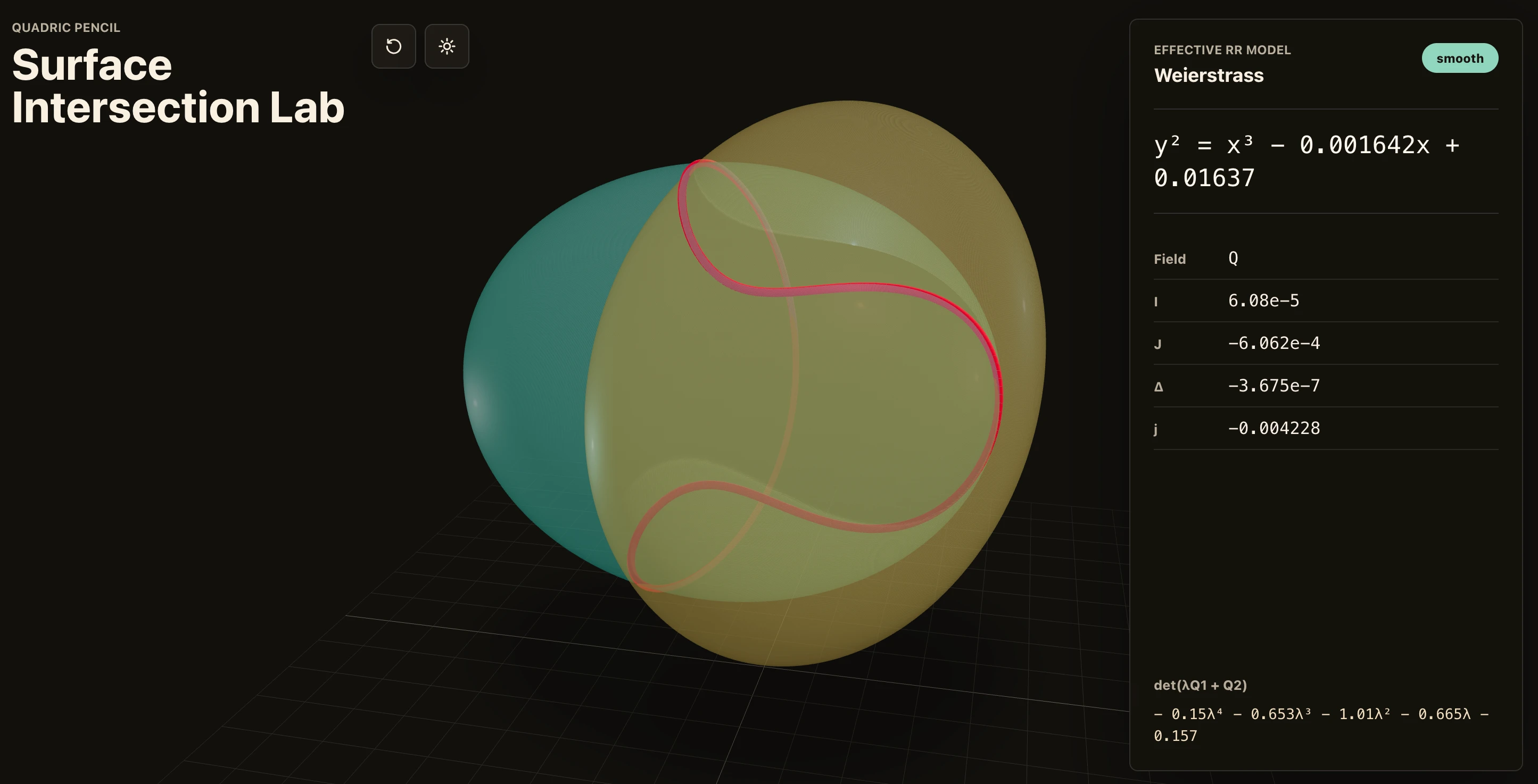
Credit: Bartosz Naskręcki(opens in a new window)
Prompt:# Algebraic geometry surface intersection
Make an app which draws two quadratic surfaces and colors in red the intersection curve. Use computational Riemann-Roch theorem to convert this into Weierstrass curve.
Main window
Two tinted surfaces with a slightly transparent shading, high quality rendering intersect along a red colored algebraic curve
Rotation with mouses in both directions, full pinch mechanism for zoom, haptic press to show the little menu with sliders for changing the coefficients of each surface; detection via Z-buffor level
Side right window
Short Weierstrass equation (over Q or quadratic field extension) computed on the go via effective Riemann-Roch theorem formulas
Ambient mode where all the controls are hidden and the user can admire the beauty of the shapes
Specs
App is running in the browser, light-weight implementation with full stack newest libraries, portable, deployable
Docs
Git repo, journal, plan (Markdown files)
“It’s incredibly energizing to use OpenAI’s new GPT-5.5 model in our harness, have it reason over massive biochemical datasets to predict human drug outcomes, and then see it deliver significant accuracy gains on our hardest drug discovery evals. If OpenAI keeps cooking like this, the foundations of drug discovery will change by the end of the year.”
— Brandon White, Co-Founder & CEO at Axiom Bio
Next-generation inference efficiency
Serving GPT‑5.5 at GPT‑5.4 latency required rethinking inference as an integrated system, not a set of isolated optimizations. GPT‑5.5 was co-designed for, trained with, and served on NVIDIA GB200 and GB300 NVL72 systems. Codex and GPT‑5.5 were instrumental in how we achieved our performance targets. Codex helped the team move faster from idea to benchmarkable implementation, sketching approaches, wiring experiments, and helping identify which optimizations were worth deeper investment. GPT‑5.5 helped find and implement key improvements in the stack itself. Put simply, the model helped improve the infrastructure that serves it.
One such improvement was load balancing and partitioning heuristics. Before GPT‑5.5, we split requests on an accelerator into a fixed number of chunks to balance work across computing cores, ensuring big and small requests could run on the same GPU. However, a pre-determined number of static chunks is not optimal for all traffic shapes. To better utilize GPUs, Codex analyzed weeks’ worth of production traffic patterns and wrote custom heuristic algorithms to optimally partition and balance work. The effort had an outsized impact, increasing token generation speeds by over 20%.
Advancing cybersecurity for everyone’s safety
Preparing the world for models that are very good at finding and patching security vulnerabilities is a team sport and will require the entire ecosystem to work hard to build resilience, with democratized model access and iterative deployment for the next era of cyber defense.
Frontier models are becoming increasingly more capable in cybersecurity. Those capabilities will become broadly distributed and we believe the best path forward is to make sure they can be put to use for accelerating cyber defense and strengthening the ecosystem.
GPT‑5.5 is an incremental but important step towards AI that can solve some of the world’s toughest challenges like cybersecurity. With GPT‑5.2 in December, we proactively deployed the necessary cyber safeguards to limit potential cyber abuse with our models; now with GPT‑5.5, we’re deploying stricter classifiers for potential cyber risk which some users may find annoying initially, as we tune them over time.
We’ve identified cybersecurity as a category in our Preparedness Framework(opens in a new window) for years as our models have incrementally improved, while we develop and calibrate mitigations iteratively, to be able to responsibly release models with meaningful cybersecurity capabilities.
-
We are deploying industry-leading safeguards for this level of cyber capability.We first introduced cyber-specific safeguards with GPT‑5.2(opens in a new window) last year, which we have continued to test, refine, and build on in subsequent deployments. For GPT‑5.5, we designed tighter controls around higher-risk activity, sensitive cyber requests, and added protections for repeated misuse. Broad access is made possible through our investments in model safety, authenticated usage, and monitoring for impermissible use. We have been working with external experts for months to develop, test and iterate on the robustness of these safeguards. With GPT‑5.5, we are ensuring developers can secure their code with ease, while putting stronger controls around the cyber workflows most likely to cause harm by malicious actors.
-
We are expanding access to accelerate cyber defense at every level.We are making our cyber-permissive models available through Trusted Access for Cyber, starting with Codex, which includes expanded access to the advanced cybersecurity capabilities of GPT‑5.5 with fewer restrictions for verified users meeting certain trust signals(opens in a new window) at launch. Organizations who are responsible for defending critical infrastructure can apply to access cyber-permissive models like GPT‑5.4‑Cyber, while meeting strict security requirements to use these models for securing their internal systems. This gives a wide range of verified defenders more capable tools for legitimate security work with less unnecessary friction to ensure we democratize access to important defensive capabilities. Users can apply for trusted access at chatgpt.com/cyber(opens in a new window) to reduce unnecessary refusals while using GPT‑5.5 for verified defensive work.
-
We are working with government partners to help protect critical infrastructure for the public.Together, we are exploring how advanced AI can support the defensive work of trusted officials responsible for systems people rely on, from the digital systems that secure important taxpayer data to the power grid and water supplies in local communities.
We are treating the biological/chemical and cybersecurity capabilities of GPT‑5.5 as High under our Preparedness Framework(opens in a new window). While GPT‑5.5 didn’t reach Critical cybersecurity capability level, our evaluations and testing showed that its cybersecurity capabilities are a step up compared to GPT‑5.4.
In addition, GPT‑5.5 went through our full safety and governance process prior to release, including preparedness evaluations, domain-specific testing, new targeted evaluations for advanced biology and cybersecurity capabilities, and robust testing with external experts. We share more details in the GPT‑5.5 system card(opens in a new window).
This work reflects our broader AI resilience approach, which we believe is needed as model capabilities advance. We want powerful AI to be available to the people using it to defend systems, institutions, and the public. The viable path is trusted access, robust safeguards that scale with capability, and the operational capacity to detect and respond to serious misuse.
Availability and pricing
Today, GPT‑5.5 is rolling out to Plus, Pro, Business, and Enterprise users in ChatGPT and Codex, and GPT‑5.5 Pro is rolling out to Pro, Business, and Enterprise users in ChatGPT. We’ll bring GPT‑5.5 and GPT‑5.5 Pro to the API very soon.
In ChatGPT, GPT‑5.5 Thinking is available to Plus, Pro, Business, and Enterprise users. GPT‑5.5 Pro, designed for even harder questions and higher-accuracy work, is available to Pro, Business, and Enterprise users.
In Codex, GPT‑5.5 is available for Plus, Pro, Business, Enterprise, Edu, and Go plans with a 400K context window. GPT‑5.5 is also available in Fast mode, generating tokens 1.5x faster for 2.5x the cost.
For API developers, gpt-5.5 will soon be available in the Responses and Chat Completions APIs at $5 per 1M input tokens and $30 per 1M output tokens, with a 1M context window. Batch and Flex pricing are available at half the standard API rate, while Priority processing is available at 2.5x the standard rate. We will also release gpt-5.5-pro in the API for even higher accuracy, priced at $30 per 1M input tokens and $180 per 1M output tokens. See the pricing page for full details.
While GPT‑5.5 is priced higher than GPT‑5.4, it is both more intelligent and much more token efficient. In Codex, we have carefully tuned the experience so GPT‑5.5 delivers better results with fewer tokens than GPT‑5.4 for most users, while continuing to offer generous usage across subscription levels.
Evaluations
Coding
EvalGPT‑5.5GPT‑5.4GPT‑5.5 ProGPT‑5.4 ProClaude Opus 4.7Gemini 3.1 Pro SWE-Bench Pro (Public) *58.6%57.7%--64.3%54.2% Terminal-Bench 2.0 82.7%75.1%--69.4%68.5% Expert-SWE (Internal)73.1%68.5%----
Professional
EvalGPT‑5.5GPT‑5.4GPT‑5.5 ProGPT‑5.4 ProClaudeOpus 4.7****Gemini 3.1 Pro GDPval (wins or ties)84.9%83.0%82.3%82.0%80.3%67.3% FinanceAgent v1.1 60.0%56.0%-61.5%64.4%59.7% Investment Banking Modeling Tasks (Internal)88.5%87.3%88.6%83.6%-- OfficeQA Pro 54.1%53.2%--43.6%18.1%
Computer use and vision
EvalGPT‑5.5GPT‑5.4GPT‑5.5 ProGPT‑5.4 ProClaudeOpus 4.7****Gemini 3.1 Pro OSWorld-Verified 78.7%75.0%--78.0%- MMMU Pro (no tools)81.2%81.2%---80.5% MMMU Pro (with tools)83.2%82.1%----
Tool use
EvalGPT‑5.5GPT‑5.4GPT‑5.5 ProGPT‑5.4 ProClaudeOpus 4.7****Gemini 3.1 Pro BrowseComp 84.4%82.7%90.1%89.3%79.3%85.9% MCP Atlas75.3%70.6%--79.1%78.2% Toolathlon 55.6%54.6%---48.8% Tau2-bench Telecom* (original prompts)98.0%92.8%----
** MCP Atlas: results from Scale AI after the latest 2026 April update. *** Tau2-bench telecom: results for 5.5 and 5.4 with original prompts i.e no prompt adjustment. This omits results from other labs that were evaluated with prompt adjustments.
Academic
EvalGPT‑5.5GPT‑5.4GPT‑5.5 ProGPT‑5.4 ProClaudeOpus 4.7****Gemini 3.1 Pro GeneBench 25.0%19.0%33.2%25.6%-- FrontierMath Tier 1–3 51.7%47.6%52.4%50.0%43.8%36.9% FrontierMath Tier 4 35.4%27.1%39.6%38.0%22.9%16.7% BixBench 80.5%74.0%---- GPQA Diamond 93.6%92.8%-94.4%94.2%94.3% Humanity's Last Exam (no tools)41.4%39.8%43.1%42.7%46.9%44.4% Humanity's Last Exam (with tools)52.2%52.1%57.2%58.7%54.7%51.4%
Cybersecurity
EvalGPT‑5.5GPT‑5.4GPT‑5.5 ProGPT‑5.4 ProClaudeOpus 4.7****Gemini 3.1 Pro Capture-the-Flags challenge tasks (Internal)****88.1%83.7%---- CyberGym 81.8%79.0%--73.1%-
**** An expansion of the hardest CTFs used in system cards with additional hard challenges.
Long context
EvalGPT‑5.5GPT‑5.4GPT‑5.5 ProGPT‑5.4 ProClaudeOpus 4.7****Gemini 3.1 Pro Graphwalks BFS 256k f1 73.7%62.5%--76.9%- Graphwalks BFS 1mil f1 45.4%9.4%--41.2% (Opus 4.6)- Graphwalks parents 256k f1 90.1%82.8%--93.6%- Graphwalks parents 1mil f1 58.5%44.4%--72.0% (Opus 4.6)- OpenAI MRCR v2 8-needle 4K-8K 98.1%97.3%---- OpenAI MRCR v2 8-needle 8K-16K 93.0%91.4%---- OpenAI MRCR v2 8-needle 16K-32K 96.5%97.2%---- OpenAI MRCR v2 8-needle 32K-64K 90.0%90.5%---- OpenAI MRCR v2 8-needle 64K-128K 83.1%86.0%---- OpenAI MRCR v2 8-needle 128K-256K 87.5%79.3%--59.2%- OpenAI MRCR v2 8-needle 256K-512K 81.5%57.5%---- OpenAI MRCR v2 8-needle 512K-1M 74.0%36.6%--32.2%-
Abstract reasoning
EvalGPT‑5.5GPT‑5.4GPT‑5.5 ProGPT‑5.4 ProClaude Opus 4.7Gemini 3.1 Pro ARC-AGI-1 (Verified)95.0%93.7%-94.5%93.5%98.0% ARC-AGI-2 (Verified)85.0%73.3%-83.3%75.8%77.1%
Evals of GPT were run with reasoning effort set to xhigh and were conducted in a research environment, which may provide slightly different output from production ChatGPT in some cases.