斯坦福新论文:信息越多,部分 LLM 智能体交易表现反而变差
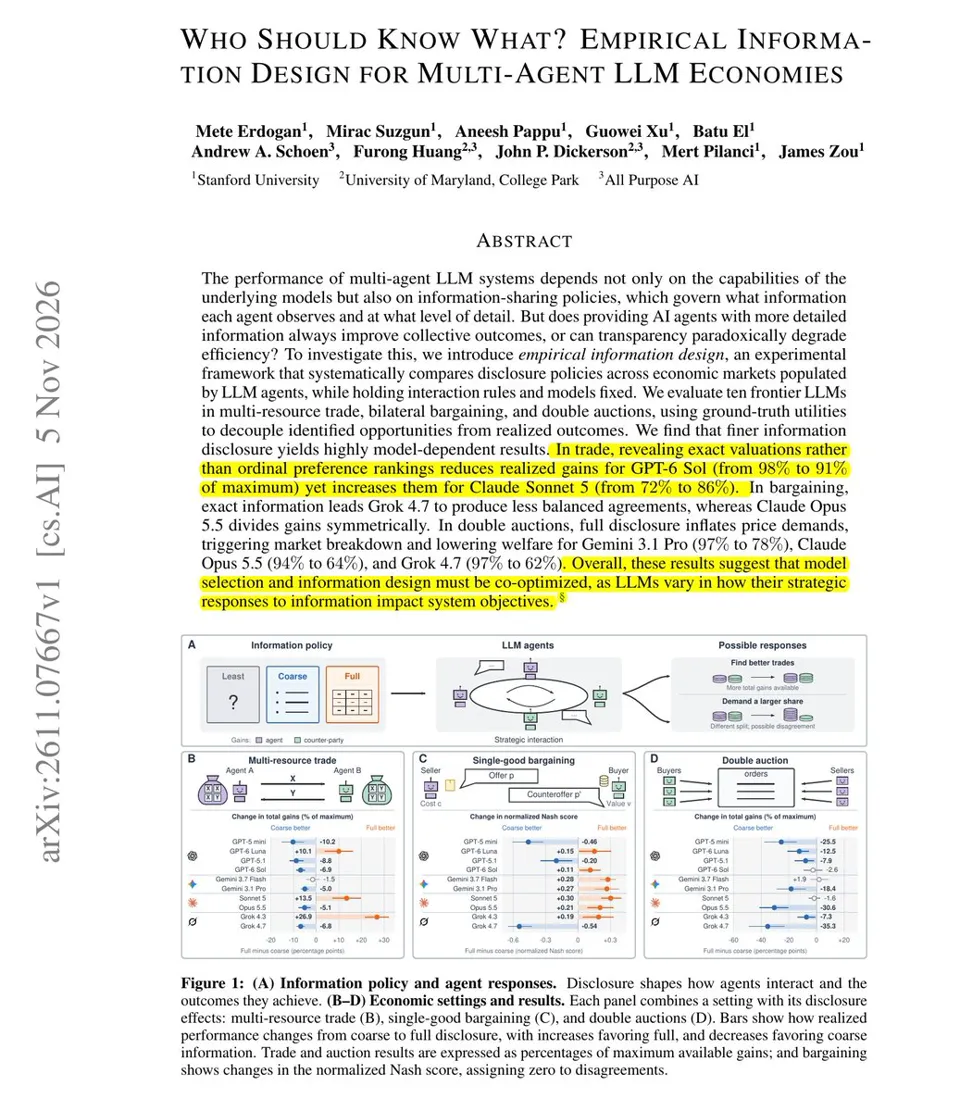
斯坦福新论文在交易、议价与双向拍卖场景中测试 10 个前沿 LLM 智能体,仅改变私有估值信息的披露精度。结果显示信息增量并非普遍有益:精确估值让 GPT-6 Sol 的收益占比从 98% 降至 91%,却让 Claude Sonnet 5 从 72% 升至 86%;拍卖中完全披露反而推高报价,Grok 4.7 从 97% 跌至 62%。结论是多智能体系统需按模型特性设计信息可见性规则。
报道正文
Rohan Paul (@rohanpaul_ai) · 2026-11-07 22
New Stanford paper shows that more information helps some LLM agents trade better and hurts others, depending on the model.
AI agents buying and selling in an auction were told exactly how much each side valued the goods, Claude Opus 5.5’s share of possible gains fell from 94% to 64%.
Multi-agent systems need rules on what each agent sees about others, such as exact prices or only rankings. The usual assumption is that more information helps.
They ran 10 frontier LLMs in trading, bargaining, and double auctions, changing only how precisely private values were shared, and scored gains against known utilities.
In trade, exact values cut GPT-6 Sol's gains from 98% to 91% of the maximum but raised Claude Sonnet 5's from 72% to 86%. In auctions, full disclosure inflated price demands and dropped Grok 4.7 from 97% to 62%.
When agents negotiate for you, test the model and what it gets told together, because more detail makes some models greedier.