Apple Framework Lets General AI Models Control Robot Arms Zero-Shot at 85.6%
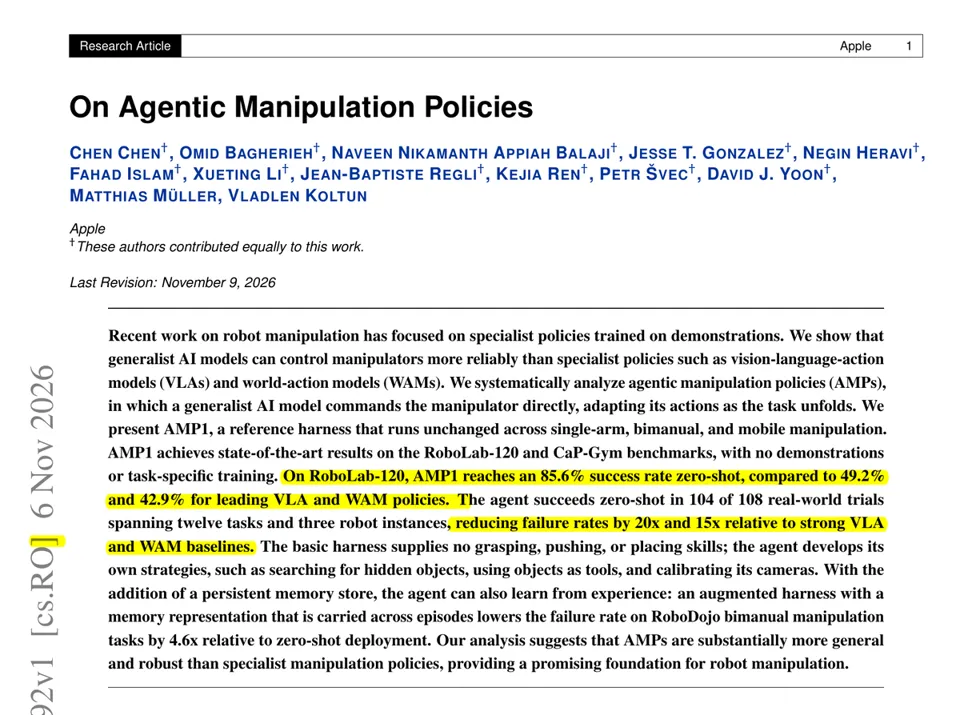
A new Apple paper introduces AMP1, a harness that lets general-purpose frontier models such as Claude Opus 5.5 and Gemini 4 Argon control a robot arm in a closed loop using camera views, code execution and direct motion commands, with no demonstrations or task-specific training. It achieves 85.6% zero-shot success on RoboLab-120 versus 49.2% for the best VLA and 42.9% for the best world-action model, and succeeds in 104 of 108 trials on a real Franka arm, though the robot idles much of each episode waiting on model inference.
Full Report
Rohan Paul (@rohanpaul_ai) · 2026-11-09 23
New Apple paper shows that a general-purpose AI model like Claude Opus 5.5, given camera views and direct control of a robot arm, handled objects more reliably than robot models trained on recorded demonstrations.
New Apple paper shows that a frontier AI model directly controlling a robot arm beats specialist robot policies, with no demonstrations or task training.
Most robot manipulation work trains specialist policies, like vision-language-action models, on demonstrations, and they break easily when instructions change.
Their harness, AMP1, gives a model like Claude Opus 5.5 or Gemini 4 Argon camera views, code execution, and direct motion commands in a loop. It has no built-in grasping or placing skills, so the model invents its own strategies.
On RoboLab-120, AMP1 succeeded in 85.6% of episodes zero-shot, against 49.2% for the best VLA and 42.9% for the best world-action model. On a real Franka arm it succeeded in 104 of 108 trials, though the robot waits much of each episode for the model.