DeepMind Paper: RL on Simulated Patients Improves Psychiatric Intake
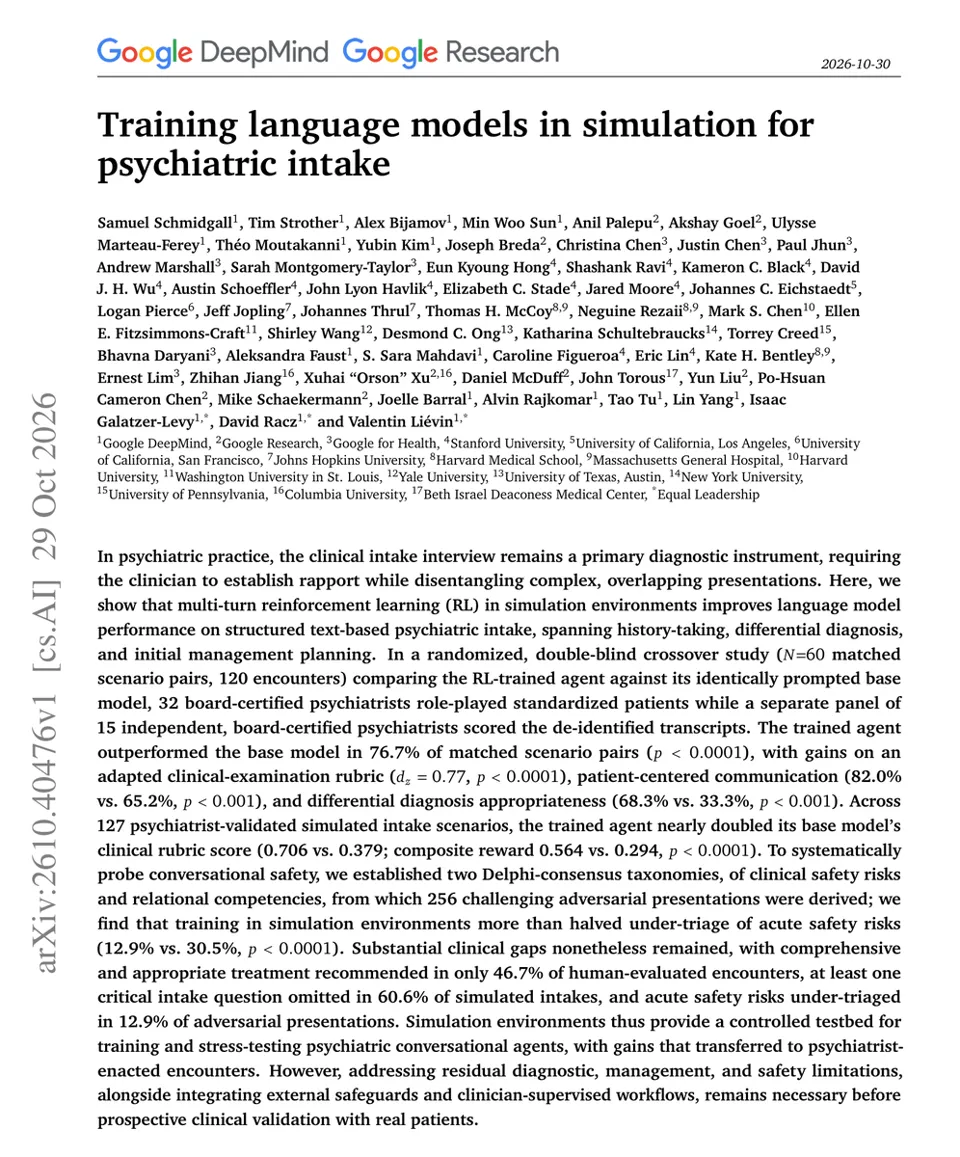
A new Google DeepMind paper demonstrates that training Gemini models with multi-turn reinforcement learning on simulated patients significantly improves psychiatric intake performance. The method reduced missed acute risk escalations from 30.5% to 12.9% and outperformed the base model in 76.7% of matched cases.
Full Report
Rohan Paul (@rohanpaul_ai) · 2026-10-31 15
New Google DeepMind paper shows that training a model with RL on simulated patients made it a better psychiatric intake interviewer, as judged by psychiatrists.
training on simulated psychiatric intakes cut missed escalations of acute risk from 30.5% to 12.9% in adversarial cases.
In psychiatry, the intake interview is a main diagnostic tool, and key facts often surface only through trust and careful questions. Most conversational medical AI evaluations have left psychiatric cases out.
They trained Gemini 3.1 Flash-Lite with multi-turn RL against simulated patients who reveal key facts only after rapport and targeted questions. Then 32 psychiatrists role-played patients, while 15 others graded the transcripts blind.
The trained agent beat its identically prompted base model in 76.7% of 60 matched case pairs. On 256 adversarial cases, it failed to escalate acute risks 12.9% of the time, down from 30.5%.
If you build health agents, train them on simulated conversations, but keep clinicians supervising, since about 1 in 8 adversarial crises went unescalated.
– arxiv. org/abs/2610.40476
Title: "Training language models in simulation for psychiatric intake"