Qwenputer Embeds RISC-V CPU in LLM for Native Precise Computation
Developer Divyansh Agrawal released Qwenputer, an experimental model based on Qwen3.5-4B that embeds a 32-bit RISC-V CPU into neural weights using Gated DeltaNet states as RAM. This enables native precise arithmetic and program execution without external tools, boosting large integer accuracy from ~50% to over 97%, though at the cost of doubling model size to 18.8GB.
Related Entities
Full Report
IT Home reported on October 30 that developer Divyansh Agrawal released the experimental model Qwenputer on October 22. Built upon Alibaba's Qwen3.5-4B, this model implements a 32-bit RISC-V CPU and memory functionality within its neural network, enabling large language models to execute programs and perform precise calculations without relying on external tools like Python.
According to IT Home, citing the project's blog post, traditional AI large language models generate responses by predicting the next token. They are prone to errors when handling large integer multiplication/division or long-chain operations, typically requiring calls to external calculators or code interpreters.
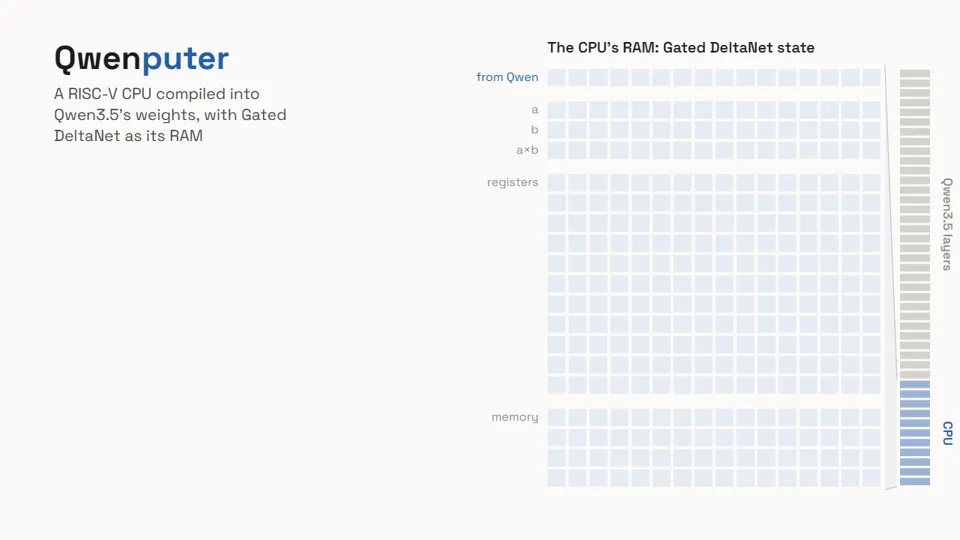
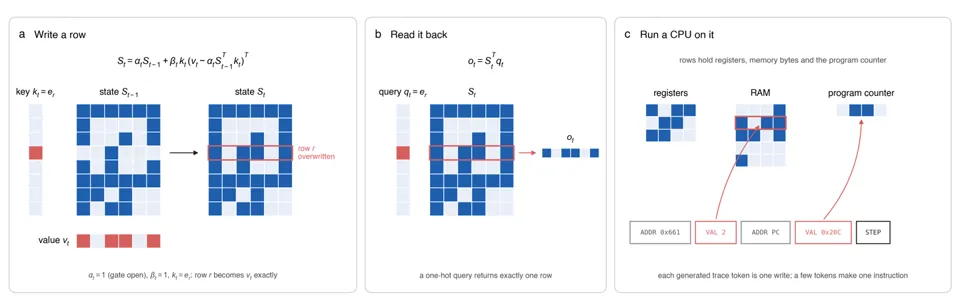
Qwenputer addresses this by "compiling" the RISC-V RV32IM instruction set and related extensions into the model weights. It utilizes the internal state of Qwen3.5's Gated DeltaNet as RAM, thereby constructing a CPU within the model capable of executing arithmetic, conditional branches, and programs.
Test results show significant improvements in accuracy. For large integer multiplication, the original Qwen3.5-4B achieved 55% accuracy, whereas Qwenputer improved this to 97.5%. For large integer division, accuracy rose from 72.5% to 97.5%. Tests involving multiple multiplication and division steps reached 100% accuracy.
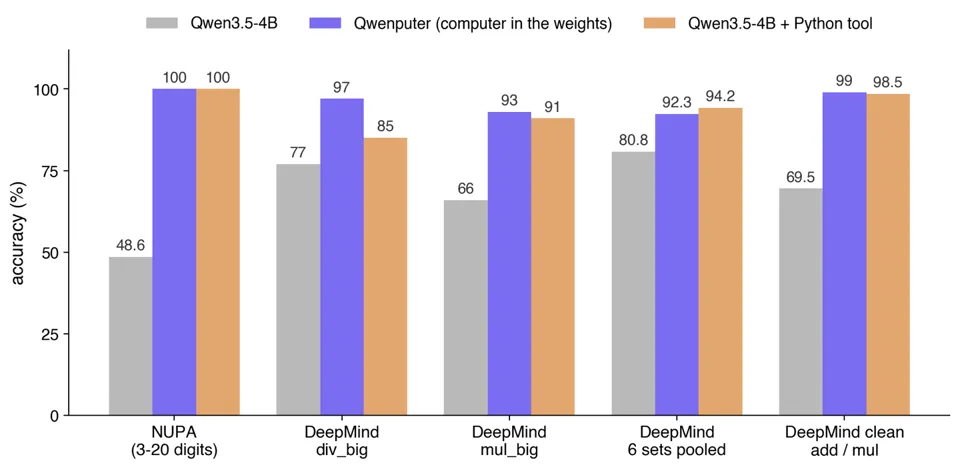
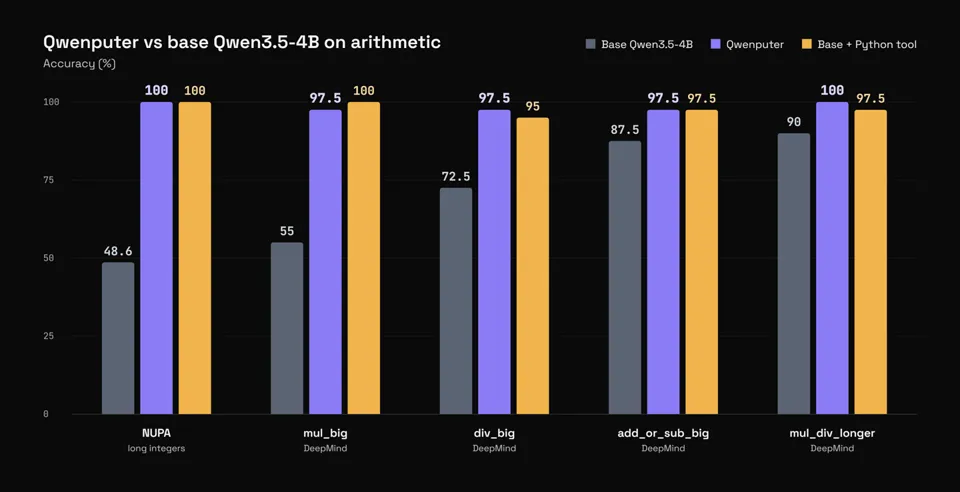
On the NUPA benchmark for long integer operations, Qwenputer achieved 100%, compared to only 48.6% for the standard version. The developer states that this CPU has passed official RISC-V tests, executing approximately 18 million consecutive instructions without error.
The project also experimentally includes an "in-model file system," capable of storing up to 512 files (approximately 53,000 tokens) within the Gated DeltaNet state and loading them in subsequent conversations. In tests, answers leveraging information saved from previous conversations achieved 90% accuracy, whereas the control method—directly inputting previous conversation content into the model—yielded only 30% accuracy.
However, Qwenputer comes with notable trade-offs: the model size increases to approximately 18.8GB, nearly double the original; each CPU instruction requires generating multiple tokens, potentially turning millisecond-level calculations into seconds-long processes; and execution requires a dedicated driver, preventing it from being loaded directly like standard large language models.
The project is open-sourced on Hugging Face and GitHub, and can run on a single GPU equipped with 24GB of VRAM.
References
- Qwenputer: a fully functioning, deterministic RISC-V CPU inside Qwen3.5
- Visit divagr1925/Qwen3.5-4B-Qwenputer on Hugging Face
- Visit the GitHub Project
Advertisement Disclosure: This article contains external links (including but not limited to hyperlinks, QR codes, and passcodes) intended to provide additional information and save selection time. Results are for reference only. All IT Home articles containing external links include this disclosure.