Ant Group's Lingbo Open-Sources LingBot-Touch Tactile Foundation Model
Ant Group's Lingbo Technology has open-sourced LingBot-Touch, a tactile foundation model pretrained on nearly 5,000 hours of real-world tactile data. It unifies signals from magnetic, vision-based and piezoresistive sensors into a single tactile representation reusable across sensors, dexterous hands, models and tasks. Across 26 real-robot tests, plugging in the representation lifted average task success for four action models by roughly 14 to 26 percentage points, with bottle-cap twisting rising from 56.25% to 90%.
Related Entities
Full Report
Contents2 sections
IT之家 November 10 news: Today, Ant Lingbo Technology open-sourced the tactile foundation model LingBot-Touch, filling in the critical tactile perception capability for the robot brain.
According to the official introduction obtained by IT之家, based on pretraining on nearly 5,000 hours of real tactile data, LingBot-Touch covers three mainstream sensing principles: magnetic tactile, visuotactile, and piezoresistive. It can convert different signals into a unified tactile representation, allowing the accumulated "sense of touch" to be reused across sensors, across dexterous hands, across models, and across tasks. In 26 real-robot tests, after incorporating this representation, the average task success rate of four action models increased by approximately 14 to 26 percentage points compared with the no-tactile setting.
Previously, the Ant Lingbo LingBot series models had already built a full-stack technical system covering high-precision spatial perception, high-dynamic environment interaction, and generalizable dexterous manipulation, enabling robots to see more clearly, think more intelligently, and act more efficiently. This time, LingBot-Touch extends the perception capability of the general brain to the "fingertips," enabling robots to "feel more sensitively," further enhancing the capabilities of the embodied-native general brain.
**After seeing clearly,**why is "feeling sensitively" still needed?
In the real physical world, every step a robot takes requires perceiving changes in objects and the environment, and then correcting the next action. In many fine manipulation tasks, seeing the object's position clearly and reaching to the correct place does not mean the task can be completed smoothly. Whether the force is appropriate after contact and whether the object slips are often difficult to judge by vision alone.
Take unscrewing a bottle cap as an example. Depth information can help the fingers align with the cap. But after rotation begins, the cap may already be loose, or the fingertip may be slipping along the cap wall. These two situations look similar in the image but require different action adjustments. The contact position of the fingertip, the magnitude of force, and their changes become important bases for the action model's judgment, yet this information is often occluded by the fingers and the object and is difficult for vision to obtain.
To verify the help of tactile representations for real manipulation, the team conducted 26 real-robot tests on two dexterous hands, Sharpa Wave and XHand, covering fine manipulation tasks such as turning book pages, unscrewing bottle caps, and recognizing mahjong tiles. After incorporating LingBot-Touch, the average task success rate of four action models—LingBot-VLA, π0.5, Diffusion Policy, and T-Rex—increased by approximately 14 to 26 percentage points compared with the no-tactile setting.
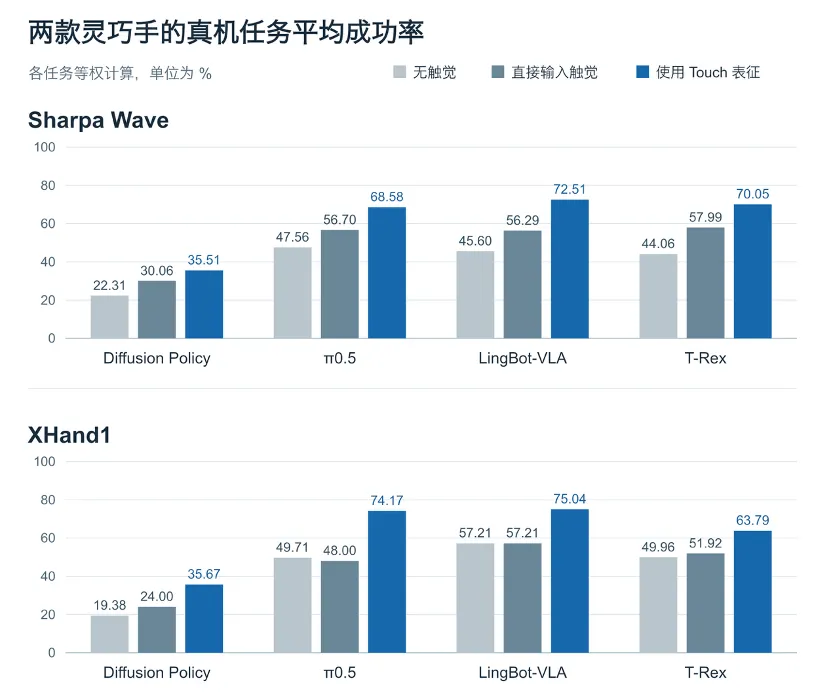
Among them, in the task of T-Rex controlling Sharpa Wave to unscrew a bottle cap, the success rate was 56.25% without touch, 62.5% when directly inputting raw sensor signals, and 90% after incorporating the LingBot-Touch tactile representation.
This series of real-robot experiments shows that high-quality tactile information input can significantly improve robot action success rates.
**Unified tactile representation,**reusable across dexterous hands and models
Installing tactile sensors on a robot does not mean it can use touch well. Commercial tactile sensors as a whole are still at an early stage of development, and routes such as visuotactile, magnetic tactile, and piezoresistive each have advantages and limitations. For different costs and usage scenarios, multiple routes may coexist for a long time.
More troublesome is that the same contact can produce different raw signals under different sensing principles and contact layouts. If a model learns to interpret only one of them, then after changing sensors or dexterous hands, the existing data and tactile experience may be difficult to reuse, requiring new data collection, training, and adaptation.
The team's approach is to free tactile understanding from dependence on the physical signals of specific sensors, enabling data from different sources to be used together for training, and allowing accumulated tactile capabilities to be reused across dexterous hands and action models.
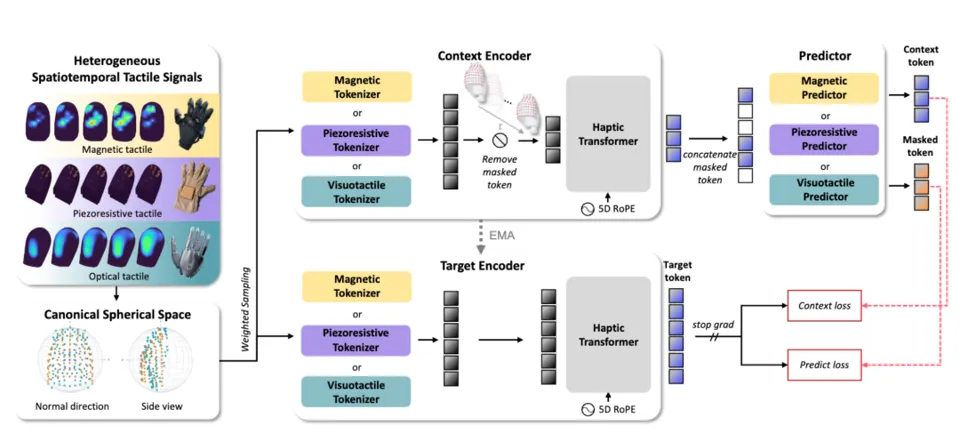
To this end, LingBot-Touch sets up separate encoding entrances according to sensing principles, first processing different raw signals, and then mapping contact points of different layouts into a unified fingertip coordinate space. The shared model learns contact position, force, and their changes over time, and outputs unified tactile tokens—tactile representations for use by different action models.
Under this architecture, data collected by humans wearing tactile gloves and by teleoperated dexterous hands can be used together for training, and different action models can also use the trained model to extract contact features. This architecture also leaves room for expansion to new types of tactile sensors in the future.
On XHand, the team further verified the cross-hardware reuse of tactile capabilities. The magnetic tactile sensor model used by XHand was not in the pretraining data; all the magnetic tactile experience learned by the model came from data collected by humans wearing gloves. After switching to this dexterous hand, the team kept the LingBot-Touch parameters unchanged and trained the action model only with XHand manipulation demonstrations.
What LingBot-Touch provides is a general perception capability located between tactile sensors and action models, rather than a dedicated module for a certain hardware or policy. This test incorporated four different action models and is not bound to the self-developed LingBot-VLA model. Sensor and dexterous-hand manufacturers can choose hardware according to cost and task requirements, and full-system teams can retain their own action policies, reducing repeated investment in redeveloping tactile capabilities when changing hardware and algorithm combinations.
To balance perception capability and on-device compute, the team provides models in two capacities. All 26 real-robot tests this time were completed using the lightweight version LingBot-Touch-Tiny with about 5.3 million parameters. After incorporating it into LingBot-VLA, π0.5, and T-Rex, the model parameter count increased by only about 0.13% to 0.16%.
The larger-capacity version, LingBot-Touch-Small, showed potential for further improvement in perception tests: when the pretraining data increased to nearly 5,000 hours, the model could still benefit from the newly added data, indicating that tactile pretraining still has room for continuous scaling and improvement.
Ant Lingbo stated that at a time when general large models are accelerating their evolution, the release of LingBot-Touch is precisely the team's continued investment in and commitment to the "embodied-native" route—unlike multimodal paradigms oriented toward digital information, robots exist in the real physical world, where information comes from sensors and acts on the environment. They need not only to understand spatial perception information such as depth, but also to process contact perception modalities such as touch, force, and temperature. The quality of modality input largely determines the quality of action output.
References
Advertisement Notice: This article contains external redirect links (including but not limited to hyperlinks, QR codes, passwords, and other forms) for the purpose of conveying more information and saving you time in selection. The results are for reference only. All articles on IT之家 that contain external links include this notice.