Harvard and MIT Study: Banning 'Okay' Boosts Reasoning Model Control
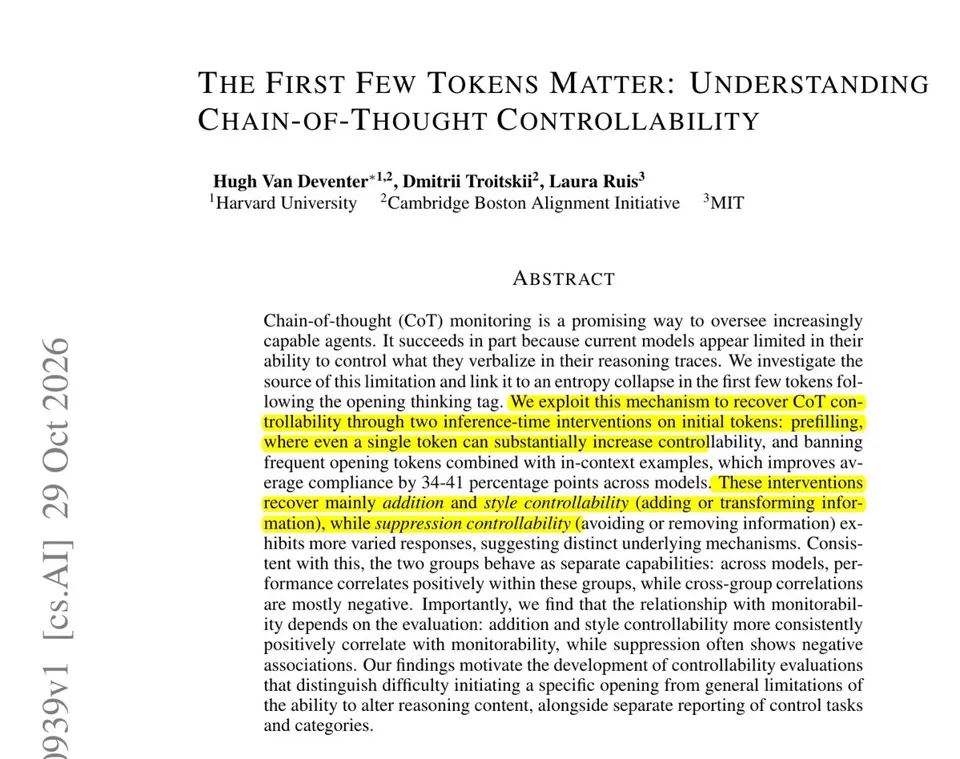
A new study reveals that reasoning models' poor chain-of-thought control stems largely from a habitual start with the word "Okay". By banning this token and prefilling one compliant token, average instruction compliance increased by 34-41 percentage points. This suggests that CoT monitoring should distinguish between opening-word bias and general controllability.
Full Report
Rohan Paul (@rohanpaul_ai) · 2026-11-03 19
New Harvard and MIT paper finds that reasoning models' poor control over their chain-of-thought partly comes from a habit of opening it with "Okay".
Safety teams read a model's reasoning to catch misbehavior, and benchmarks showing models can't steer that reasoning have been reassuring. Why models fail at this was unclear.
The authors told models like Qwen3-32B to reason in uppercase or number each sentence. Qwen3-32B and OLMo-3.1-32B put about 99% of first-token probability on "Okay", so the authors tried banning it or prefilling 1 compliant token.
Banning "Okay" and "Alright" and adding 1 worked example raised average compliance by 34 to 41 percentage points over instructions alone. Tasks that hide information, like avoiding a word, responded less consistently and look like a separate skill across 12 models.
If you trust chain-of-thought monitoring because of controllability scores, separate the opening-word problem from general control and report hiding tasks separately.