Zhiyuan AI Unveils WITA-Omni Embodied Omni-Modal Interaction Model
Zhiyuan AI has released WITA-Omni, billed as the industry's first embodied omni-modal end-to-end interaction model, adding tactile and proprioceptive inputs plus robot action and facial-expression outputs beyond audio and video. Built on a streaming full-duplex architecture, it delivers interaction latency as low as roughly 400 ms and about 600 ms on average, nearly 3x faster than industry norms, while supporting wake-word-free omni-modal rejection and streaming simultaneous interpretation across 100+ languages and dialects.
Related Entities
Full Report
IT之家 November 10 news, the "智元 AGIBOT" official account announced in a post this evening (the 10th) that AgiBot has officially released WITA-Omni (Silicon Photonic Motion Language Omni-modal Large Model).
According to the official introduction, this model is also the industry's first embodied omni-modal end-to-end interaction large model. WITA-Omni is deeply trained on the robot body's proprioceptive data. In addition to audio-visual input and output, it also newly supports inputs such as touch and body state, as well as outputs such as robot actions and facial expressions, giving robots for the first time an "interaction brain" born for the physical world.
Based on a streaming full-duplex architecture, WITA-Omni can listen, think, respond, move, and make expressions simultaneously, reducing the waiting in traditional serial processing. Interaction response is as fast as about 400 milliseconds, with an average of about 600 milliseconds, nearly 3 times faster than the industry average.
At the same time, omni-modal rejection enables robot interaction to no longer require a wake word, allowing natural conversation throughout. The system combines conversation orientation, video, audio, voiceprint, lip movement, posture, semantics, and context to decide whether the current speech needs a response. When faced with interference such as multi-person conversations or environmental broadcasts, it greatly reduces false triggers, making the robot better at "reading the room."
WITA-Omni supports free communication without switching across hundreds of languages and dialects, and combined with the full-duplex architecture, it enables streaming simultaneous interpretation (language interpretation & dialect interpretation), as well as bidirectional translation.
WITA-Omni's emotional expressiveness is more human-like. When listening, the robot can respond through subtle expressions and natural head movements; when expressing, it combines parameterized facial expressions, expressive voice, and coordinated body movements to vividly present dozens of emotions such as happiness, surprise, excitement, sadness, satisfaction, crying, seriousness, and confidence. Each emotion can also show different intensities: the same happiness can be a faint smile or hearty laughter, making conversations more real and warmer.
WITA-Omni can not only speak, see, and move, but also draw. For example, when it wants to explain a complex product, or tell a child a small popular science fact, WITA-Omni will make intelligent decisions and visualize in real time on the facial screen content that is hard to explain in words, letting users understand at a glance.
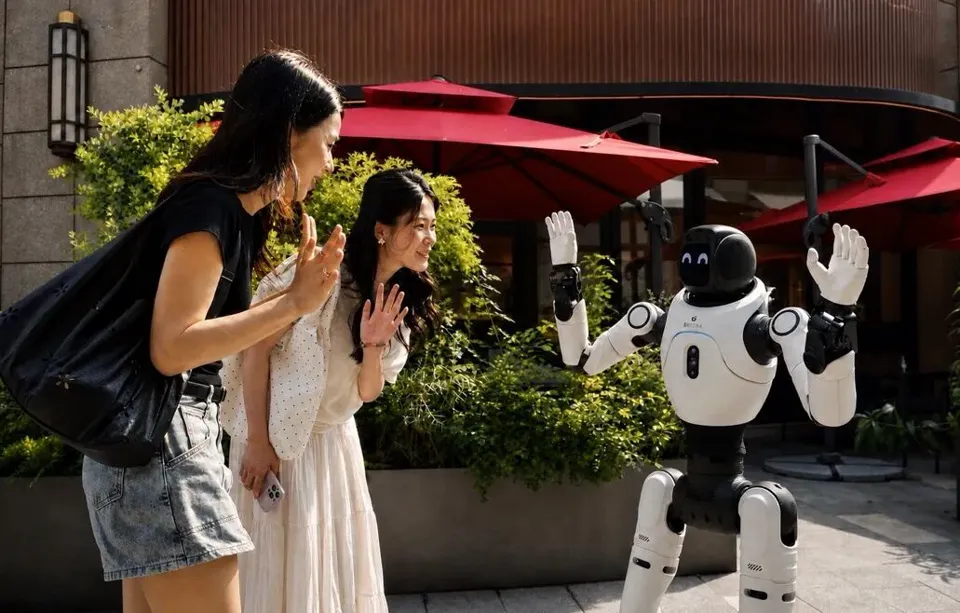
In addition, WITA-Omni can continuously perceive the surrounding environment, the user's state and its changes, think and make decisions autonomously, and take action, proactively initiating interaction at the appropriate moment. The official claim is that robots can also have their own "little thoughts": when seeing a VIP, they will proactively welcome and extend a hand for a handshake; when receiving a thumbs-up, they will respond happily; when seeing a user wave goodbye, they will immediately wave back.
According to IT之家's previous report, in July this year, the WITA-Omni Preview model topped the DailyOmni omni-modal understanding leaderboard with a comprehensive score of 85.21, surpassing leading domestic and international models such as Qwen, Gemini, Doubao, and NVIDIA, and ranking first in six of eight sub-indicators.