Cohere Paper Validates Speculative Decoding for Low-Batch MoE Models
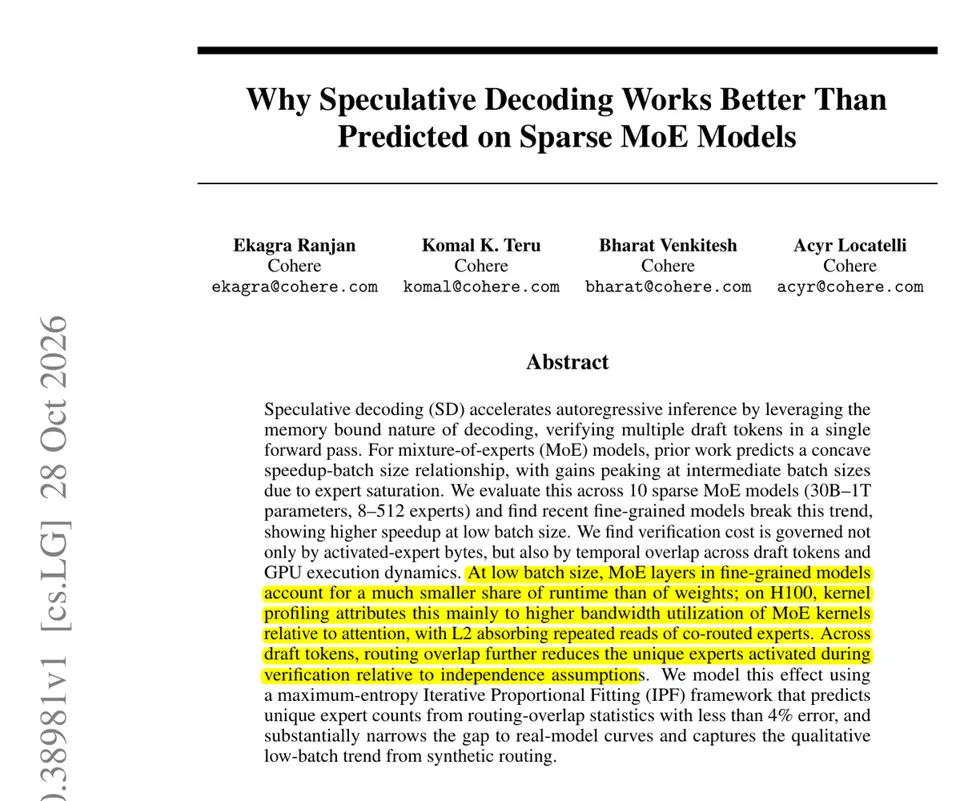
A new Cohere paper challenges the assumption that speculative decoding yields minimal gains for Mixture-of-Experts (MoE) models at low batch sizes. The study reveals that adjacent tokens share 20-45% of their experts—far exceeding theoretical predictions—making verification steps highly efficient. On models like Qwen3-235B, verification runs at 89% of normal decoding speed, offering a viable optimization path for agent workloads.
Full Report
Rohan Paul (@rohanpaul_ai) · 2026-11-02 21
New @cohere paper finds that speculative decoding works well on fine-grained MoE models even at batch size 1, where prior work predicted small gains.
Finds that in mixture-of-experts models, neighboring tokens share 20% to 45% of their experts, against 4% to 12% expected, which makes speculative decoding cheaper than predicted.
Speculative decoding lets a small drafter propose tokens that the big model checks in 1 pass. For MoE models, prior work said checking several tokens loads many extra experts, limiting gains at low batch sizes.
They tested 10 MoE models from 30B to 1T parameters and profiled them on H100 GPUs. Consecutive tokens reuse many experts, and small experts use GPU bandwidth well, so checking extra tokens costs little.
Adjacent tokens shared 20% to 45% of their experts, against 4% to 12% expected from independent routing. For Qwen3-235B in FP8, the verification pass ran at 89% of a normal decoding step's speed, against 52% predicted.
For low-batch MoE serving, such as agent workloads, benchmark speculative decoding on your hardware instead of ruling it out.