Understanding the 4 Main Approaches to LLM Evaluation
By Sebastian Raschka, PhDOriginal title: Understanding the 4 Main Approaches to LLM Evaluation (From Scratch)
68AI Score
This article systematically outlines four main approaches to evaluating Large Language Models (LLMs), providing a clear mental map for developers. It combines from-scratch code examples with deep dives into benchmarks and human preference methods, while highlighting the limitations of multiple-choice tests like MMLU in measuring real-world utility.
How do we actually evaluate LLMs?
It’s a simple question, but one that tends to open up a much bigger discussion.
When advising or collaborating on projects, one of the things I get asked most often is how to choose between different models and how to make sense of the evaluation results out there. (And, of course, how to measure progress when fine-tuning or developing our own.)
Since this comes up so often, I thought it might be helpful to share a short overview of the main evaluation methods people use to compare LLMs. Of course, LLM evaluation is a very big topic that can’t be exhaustively covered in a single resource, but I think that having a clear mental map of these main approaches makes it much easier to interpret benchmarks, leaderboards, and papers.
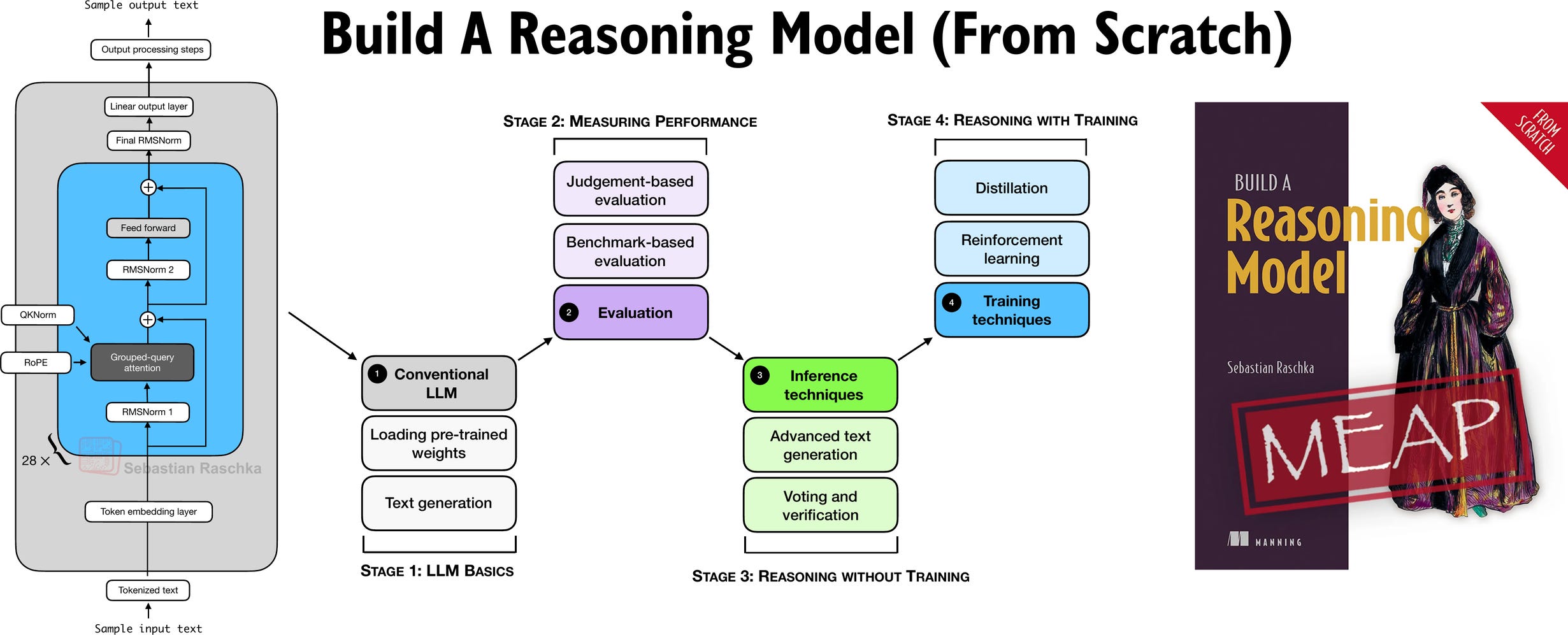
I originally planned to include these evaluation techniques in my upcoming book, Build a Reasoning Model (From Scratch), but they ended up being a bit outside the main scope. (The book itself focuses more on verifier-based evaluation.) So I figured that sharing this as a longer article with from-scratch code examples would be nice.
In Build A Reasoning Model (From Scratch), I am taking a hands-on approach to building a reasoning LLM from scratch.
If you liked “Build A Large Language Model (From Scratch)”, this book is written in a similar style in terms of building everything from scratch in pure PyTorch.
Reasoning is one of the most exciting and important recent advances in improving LLMs, but it’s also one of the easiest to misunderstand if you only hear the term reasoning and read about it in theory. So, in this book, I am taking a hands-on approach to building a reasoning LLM from scratch.
The book is currently in early-access with >100 pages already online, and I have just finished another 30 pages that are currently being added by the layout team. If you joined the early access program (a big thank you for your support!), you should receive an email when those go live.
PS: There’s a lot happening on the LLM research front right now. I’m still catching up on my growing list of bookmarked papers and plan to highlight some of the most interesting ones in the next article.
But now, let’s discuss the four main LLM evaluation methods along with their from-scratch code implementations to better understand their advantages and weaknesses.
Understanding the main evaluation methods for LLMs
There are four common ways of evaluating trained LLMs in practice: multiple choice, verifiers, leaderboards, and LLM judges, as shown in Figure 1 below. Research papers, marketing materials, technical reports, and model cards (a term for LLM-specific technical reports) often include results from two or more of these categories.
Figure 1: An overview of the 4 different evaluations models covered in this article.
Furthermore the four categories introduced here fall into two groups: benchmark-based evaluation and judgment-based evaluation, as shown in the figure above.
(There are also other measures, such as training loss,perplexity, and rewards, but they are usually used internally during model development.)
The following subsections provide brief overviews and examples of each of the four methods.
Method 1: Evaluating answer-choice accuracy
We begin with a benchmark‑based method: multiple‑choice question answering.
Historically, one of the most widely used evaluation methods is multiple-choice benchmarks such as MMLU (short for Massive Multitask Language Understanding, https://huggingface.co/datasets/cais/mmlu). To illustrate this approach, figure 2 shows a representative task from the MMLU dataset.
Figure 2: Evaluating an LLM on MMLU by comparing its multiple-choice prediction with the correct answer from the dataset.
Figure 2 shows just a single example from the MMLU dataset. The complete MMLU dataset consists of 57 subjects (from high school math to biology) with about 16 thousand multiple-choice questions in total, and performance is measured in terms of accuracy (the fraction of correctly answered questions), for example 87.5% if 14,000 out of 16,000 questions are answered correctly.
Multiple-choice benchmarks, such as MMLU, test an LLM’s knowledge recall in a straightforward, quantifiable way similar to standardized tests, many school exams, or theoretical driving tests.
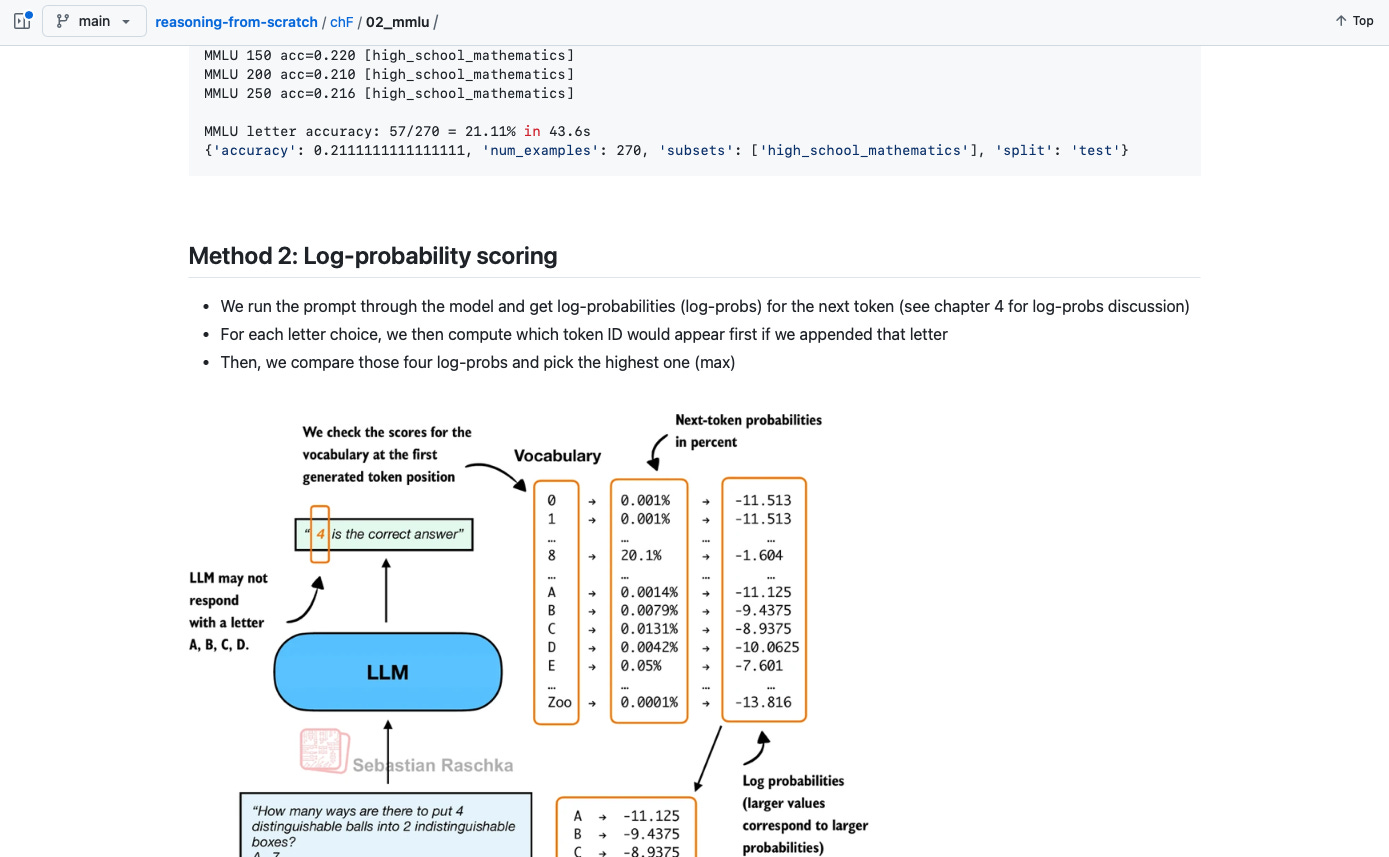
Note that figure 2 shows a simplified version of multiple-choice evaluation, where the model’s predicted answer letter is compared directly to the correct one. Two other popular methods exist that involve log-probability scoring. I implemented them here on GitHub. (As this builds on the concepts explained here, I recommended checking this out after completing this article.)
The following subsections illustrate how the MMLU scoring shown in figure 2 can be implemented in code.
1.2 Loading the model
First, before we can evaluate it on MMLU, we have to load the pre-trained model. Here, we are going to use a from-scratch implementation of Qwen3 0.6B in pure PyTorch, which requires only about 1.5 GB of RAM.
Note that the Qwen3 model implementation details are not important here; we simply treat it as an LLM we want to evaluate. However, if you are curious, a from-scratch implementation walkthrough can be found in my previous Understanding and Implementing Qwen3 From Scratch article, and the source code is also available here on GitHub.
Instead of copy & pasting the many lines of Qwen3 source code, we import it from my reasoning_from_scratch Python library, which can be installed via
BASH
pip install reasoning_from_scratch
or
Text
uv add reasoning_from_scratch
Code block 1: Loading a pre-trained model
PYTHON
from pathlib import Path
import torch
from reasoning_from_scratch.ch02 import get_device
from reasoning_from_scratch.qwen3 import (
download_qwen3_small, Qwen3Tokenizer,
Qwen3Model, QWEN_CONFIG_06_B
)
device = get_device()
# Set matmul precision to "high" to # enable Tensor Cores on compatible GPUs
torch.set_float32_matmul_precision("high")
# Uncomment the following line # if you encounter device compatibility issues# device = "cpu"# Use the base model by default
WHICH_MODEL = "base"if WHICH_MODEL == "base":
download_qwen3_small(
kind="base", tokenizer_only=False, out_dir="qwen3"
)
tokenizer_path = Path("qwen3") / "tokenizer-base.json"
model_path = Path("qwen3") / "qwen3-0.6B-base.pth"
tokenizer = Qwen3Tokenizer(tokenizer_file_path=tokenizer_path)
elif WHICH_MODEL == "reasoning":
download_qwen3_small(
kind="reasoning", tokenizer_only=False, out_dir="qwen3"
)
tokenizer_path = Path("qwen3") / "tokenizer-reasoning.json"
model_path = Path("qwen3") / "qwen3-0.6B-reasoning.pth"
tokenizer = Qwen3Tokenizer(
tokenizer_file_path=tokenizer_path,
apply_chat_template=True,
add_generation_prompt=True,
add_thinking=True,
)
else:
raise ValueError(f"Invalid choice: WHICH_MODEL={WHICH_MODEL}")
model = Qwen3Model(QWEN_CONFIG_06_B)
model.load_state_dict(torch.load(model_path))
model.to(device)
# Optionally enable model compilation for potential performance gains
USE_COMPILE = Falseif USE_COMPILE:
torch._dynamo.config.allow_unspec_int_on_nn_module = True
model = torch.compile(model)
1.3 Checking the generated answer letter
In this section, we implement the simplest and perhaps most intuitive MMLU scoring method, which relies on checking whether a generated multiple-choice answer letter matches the correct answer. This is similar to what was illustrated earlier in Figure 2, which is shown below again for convenience.
Figure 3: Evaluating an LLM on MMLU by comparing its multiple-choice prediction with the correct answer from the dataset.
For this, we will work with an example from the MMLU dataset:
YAML
example= {
"question":("How many ways are there to put 4 distinguishable"" balls into 2 indistinguishable boxes?"),
“choices”: ["7", "11", "16", "8"],
“answer”:"D",
}
Next, we define a function to format the LLM prompts.
Code block 2: Loading a pre-trained model
PYTHON
defformat_prompt(example):
return (
f"{example['question']}\n"f"A. {example['choices'][0]}\n"f"B. {example['choices'][1]}\n"f"C. {example['choices'][2]}\n"f"D. {example['choices'][3]}\n""Answer: "
)
# Trailing space in "Answer: " encourages a single-letter next token
Let’s execute the function on the MMLU example to get an idea of what the formatted LLM input looks like:
PYTHON
prompt = format_prompt(example)
print(prompt)
The output is:
How many ways are there to put 4 distinguishable balls into 2
indistinguishable boxes?
Text
How many ways are there to put 4 distinguishable balls into 2
indistinguishable boxes?
A. 7
B. 11
C. 16
D. 8
Answer:
The model prompt, as shown above, provides the model with a list of the different answer choices and ends with an “Answer: “ text that encourages the model to generate the correct answer.
While it is not strictly necessary, it can sometimes also be helpful to provide additional questions along with the correct answers as input, so that the model can observe how it is expected to solve the task. (For example, cases where 5 examples are provided are also known as 5-shot MMLU.) However, for current generations of LLMs, where even the base models are quite capable, this is not required.
Loading different MMLU samples
You can load examples from the MMLU dataset directly via the datasets library (which can be installed via pip install datasets or uv add datasets):
Text
from datasets import load_dataset
configs = get_dataset_config_names("cais/mmlu")
dataset = load_dataset("cais/mmlu", "high_school_mathematics")
# Inspect the first example from the test set:
example = dataset["test"][0]
print(example)
Above, we used the “high_school_mathematics” subset; to get a list of the other subsets, use the following code:
Text
from datasets import get_dataset_config_names
subsets = get_dataset_config_names("cais/mmlu")
print(subsets)
Next, we tokenize the prompt and wrap it in a PyTorch tensor object as input to the LLM:
Then, with all that setup out of the way, we define the main scoring function below, which generates a few tokens (here, 8 tokens by default) and extracts the first instance of letter A/B/C/D that the model prints.
Code block 3: Extracting the generated letter
PYTHON
from reasoning_from_scratch.ch02_ex import (
generate_text_basic_stream_cache
)
defpredict_choice(
model, tokenizer, prompt_fmt, max_new_tokens=8):
pred = Nonefor t in generate_text_basic_stream_cache(
model=model,
token_ids=prompt_fmt,
max_new_tokens=max_new_tokens,
eos_token_id=tokenizer.eos_token_id,
):
answer = tokenizer.decode(t.squeeze(0).tolist())
for letter in answer:
letter = letter.upper()
# stop as soon as a letter appearsif letter in"ABCD":
pred = letter
breakif pred:
breakreturn pred
We can then check the generated letter using the function from the code block above as follows:
As we can see, the generated answer is incorrect (False) in this case.
This was just one of the 270 examples from the high_school_mathematics subset in MMLU. The screenshot (Figure 4) below show’s the performance of the base model and reasoning variant when executed on the complete subset. The code for this is available here on GitHub.
Figure 4: Base and reasoning model performance on the MMLU high_school_mathematics subset
Assuming the questions have an equal answer probability, a random guesser (with uniform probability choosing A, B, C, or D) is expected to achieve 25% probability. So the both the base and reasoning model are not very good.
Multiple-choice answer formats
Note that this section implemented a simplified version of multiple-choice evaluation for illustration purposes, where the model’s predicted answer letter is compared directly to the correct one. In practice, more widely used variations exist, such as log-probability scoring, where we measure how likely the model considers each candidate answer rather than just checking the final letter choice. (We discuss probability-based scoring in chapter 4.) For reasoning models, evaluation can also involve assessing the likelihood of generating the correct answer when it is provided as input.
Figure 5: Other MMLU scoring methods are described and shared on GitHub here
However, regardless of which MMLU scoring variant we use, the evaluation still amounts to checking whether the model selects from the predefined answer options.
A limitation of multiple‑choice benchmarks like MMLU is that they only measure an LLM’s ability to select from predefined options and thus is not very useful for evaluating reasoning capabilities besides checking if and how much knowledge the model has forgotten compared to the base model. It does not capture free-form writing ability or real-world utility.
Still, multiple-choice benchmarks remain simple and useful diagnostics: for example, a high MMLU score doesn’t necessarily mean the model is strong in practical use, but a low score can highlight potential knowledge gaps.
 Reasoning is one of the most exciting and important recent advances in improving LLMs, but it’s also one of the easiest to misunderstand if you only hear the term reasoning and read about it in theory. So, in this book, I am taking a hands-on approach to building a reasoning LLM from scratch.
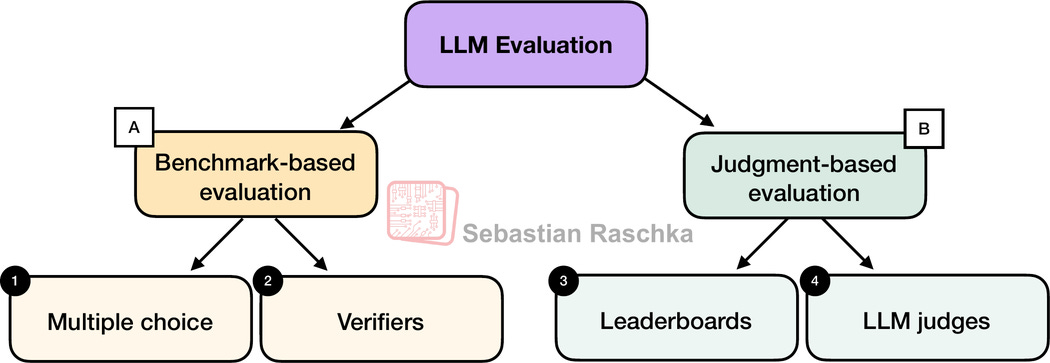
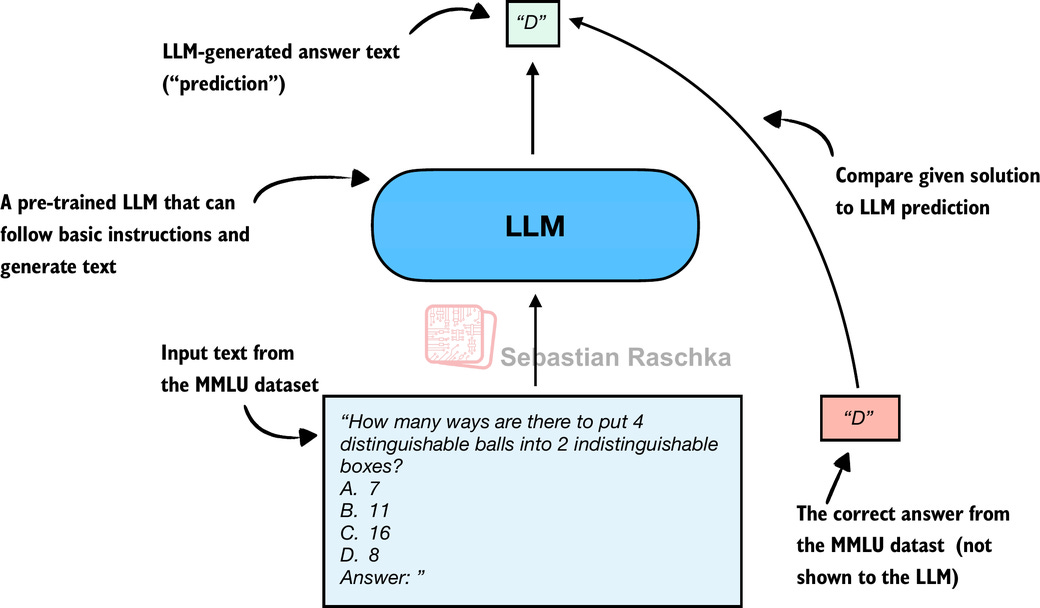 Figure 2: Evaluating an LLM on MMLU by comparing its multiple-choice prediction with the correct answer from the dataset.
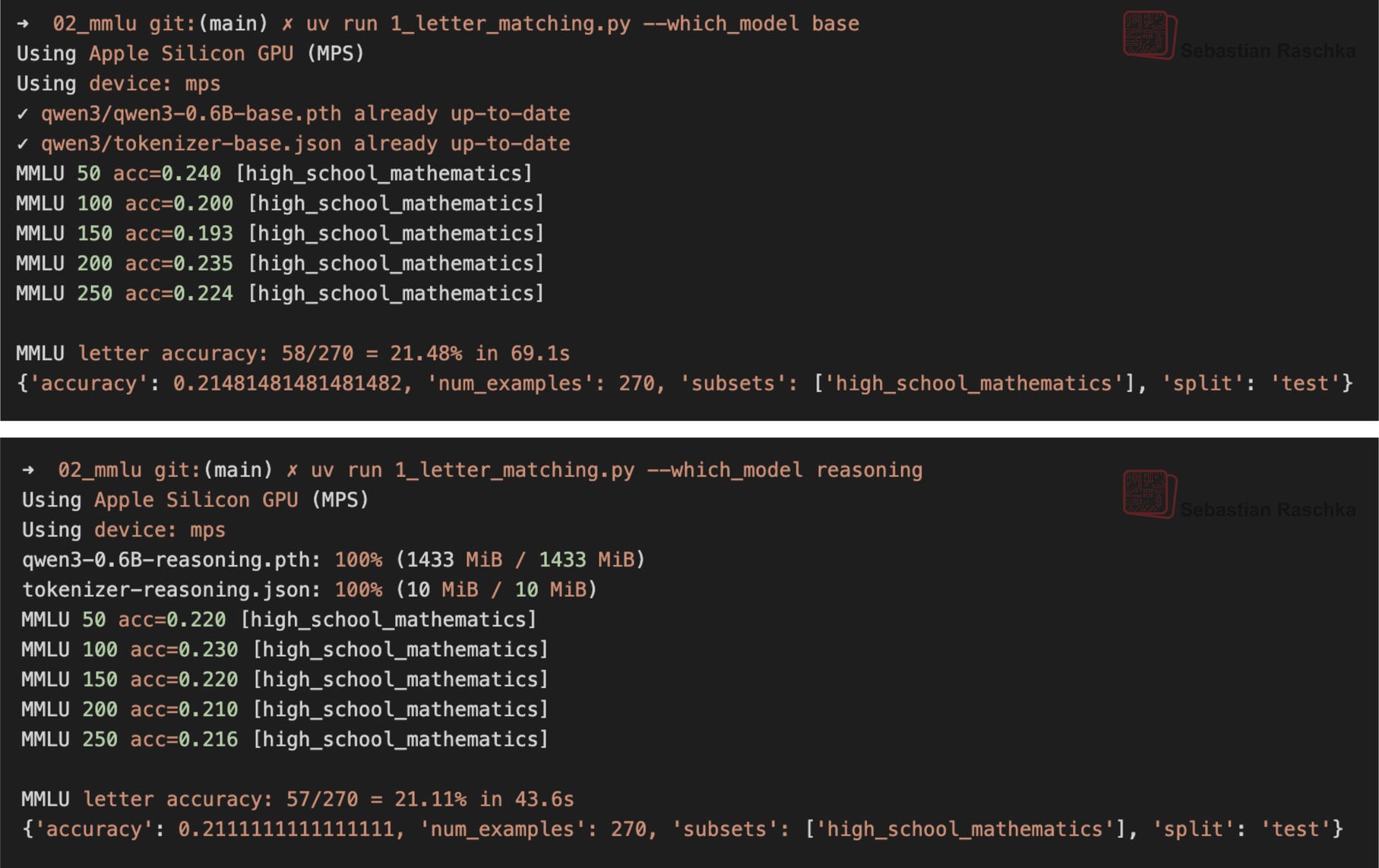 Figure 4: Base and reasoning model performance on the MMLU
Figure 5: Other MMLU scoring methods are described and shared on GitHub here However, regardless of which MMLU scoring variant we use, the evaluation still amounts to checking whether the model selects from the predefined answer options.