AI Outperforms Human Reviewers in Detecting Clinical Trial Paper Errors
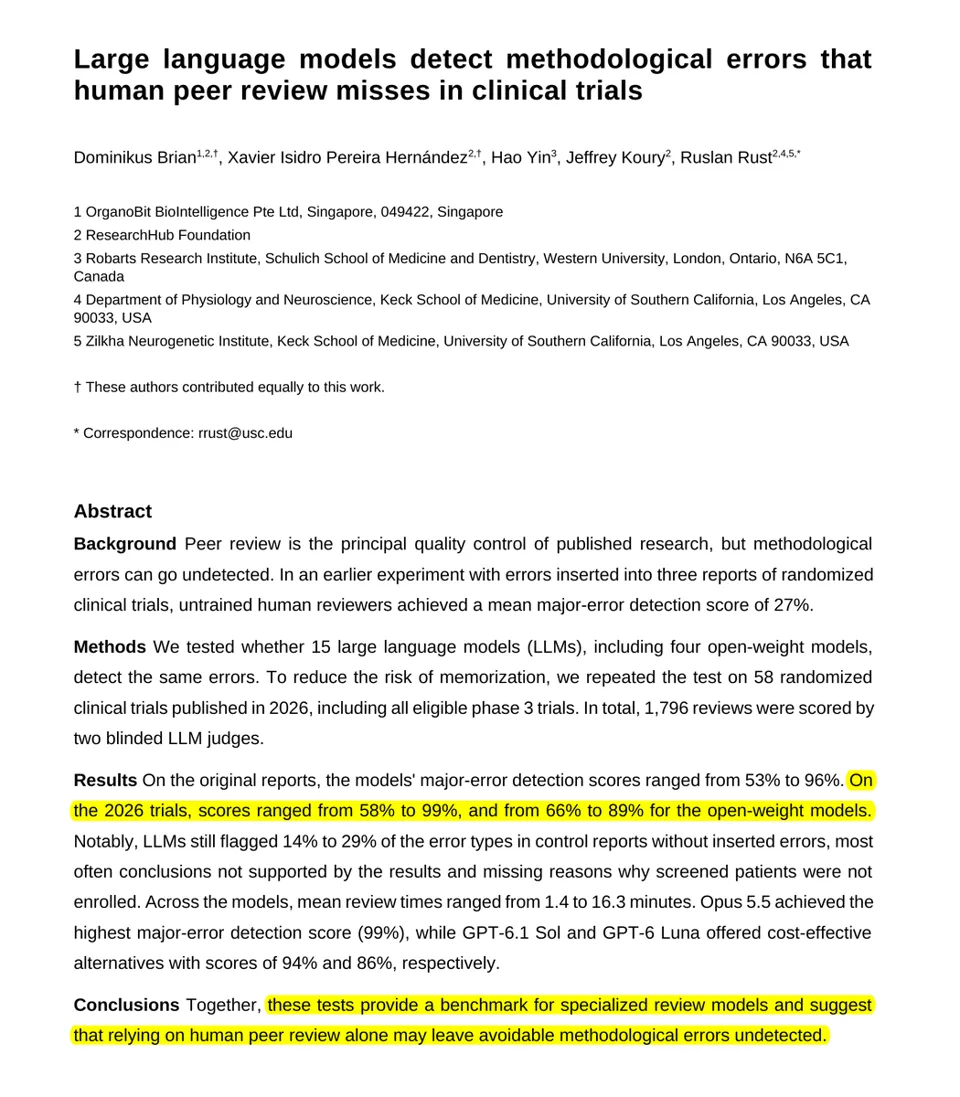
A new preprint study reveals that 15 mainstream LLMs significantly outperform untrained human peer reviewers in detecting errors in clinical trial papers. All tested models achieved error detection rates between 53% and 96%, compared to a human average of just 27%, with Claude Opus 5.5 scoring highest at 99%. Furthermore, AI demonstrated superior capability in identifying critical semantic inconsistencies, such as text-table contradictions, while reducing review time from hours to minutes.
Full Report
Rohan Paul (@rohanpaul_ai) · 2026-10-29 00
AI now catches far more errors in clinical trial papers than human peer reviewers: all 15 models tested scored 53% to 96% on planted errors, while untrained human reviewers averaged just 27%.
The result held on 58 new trials published in 2026, so the models weren’t simply recalling old papers they had seen in training; Claude Opus 5.5 scored highest at 99%.
Humans miss the errors that most change a trial’s meaning, catching text-table contradictions only 7% of the time, and they take 5 to 8.5 hours per review against AI’s 1.4 to 16.3 minutes.
↳ 引用 @rust_ruslan (Ruslan Rust): Lots of debate this week on whether journals should ban AI in peer review.
We actually tested this in our new preprint, and the results were pretty clear to me.
For context, I've reviewed for most of the big journals and evaluated 1,000 human reviews as an editor. I love to read and evaluate science.
TLDR: From now on I won't do any peer review without AI. For clinical trials, I'd even call human-only review dangerous 🧵